The issue 7 of the international electronic scientific journal Natural Science Review, founded and published by the Joint Institute for Nuclear Research, includes the article "Distribution of High Field Strength Elements in the river sediments of Nile (Egypt) and Zarafshon (Tajikistan) as investigated by Instrumental Neutron Activation Analysis", prepared on the results of cooperation between a team of authors from the Frank Laboratory of Neutron Physics (W. M. Badawy, M. V. Frontasyeva, I. Zinicovscaia, P. S. Nekhoroshkov), Flerov Laboratory of Nuclear Reactions (D. Abdusamadzoda), University of Bucharest, Romania (O. G. Duliu), Institute of Water Problems, Hydropower and Ecology of the National Academy of Sciences of Tajikistan (D. A. Abdushukurov) and Menoufia University, Egypt (H. El-Samman).
The results of estimating the content of two incompatible elements (Co and Ni) and 13 High Field Strength Elements in unconsolidated bottom sediments belonging to two different river systems (the Egyptian sector of the Nile and the Tajik sector of Zarafshon) using Instrumental Neutron Activation Analysis are presented in the paper. A total of 38 and 29 samples of unconsolidated sediment were collected along the Nile and Zarafshon rivers, respectively. In the vast majority of cases, the distribution functions of the mass fractions were not regular, as proved by the Shapiro-Wilk, Anderson-Darling, Lillifors and Jarque–Bera ANOVA tests. More discriminating bi-plots and ternary diagrams were best to compare the distribution functions of the considered elements. All of them showed the relative similarity of both types of sedimentary material with less recycled felsic type of rocks. Despite it, further detailed analysis revealed systematic differences between the two sediment categories. This discovery suggests that the Nile sediments were influenced by the mafic material that was transported from the basalt-rich Ethiopian highlands along the Blue Nile.
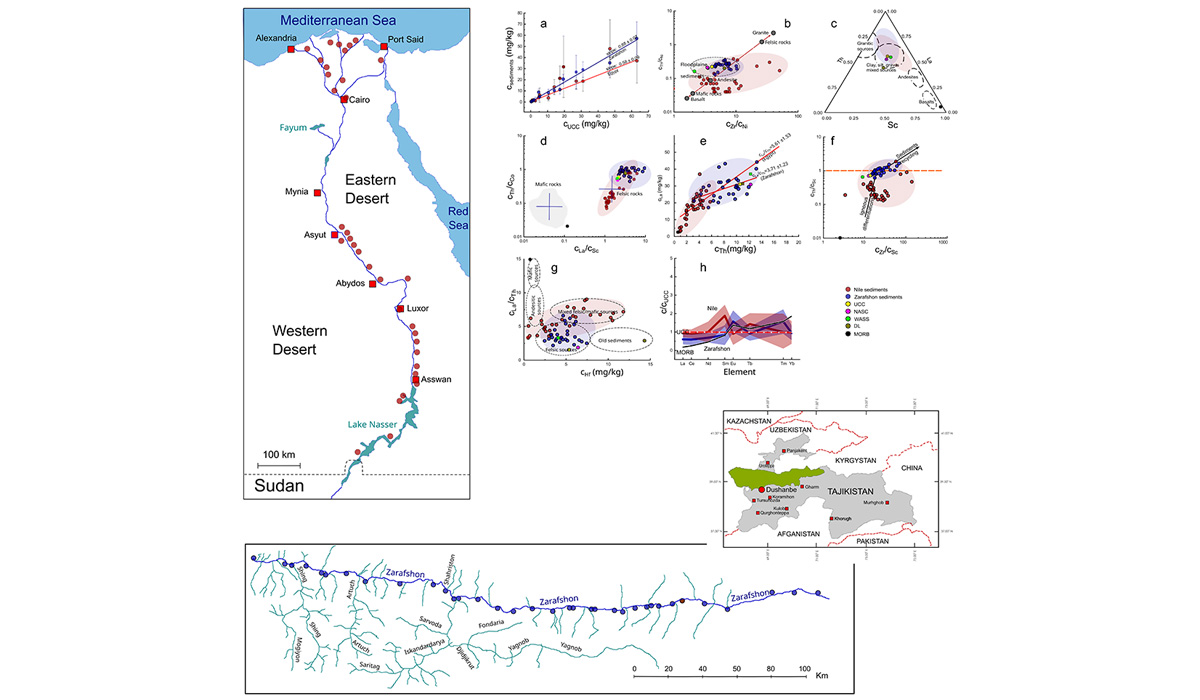
The results of the research have been obtained using the high-precision neutron activation analysis at the REGATA instrument of the IBR-2 pulsed reactor that allows estimating up to 50 elements in samples. The research has become the result of many years of cooperation between the scientists from JINR and the scientific organizations in Romania, Tajikistan and Egypt.
Author Zinicovscaia Inga
Translator Voskanyan Elena