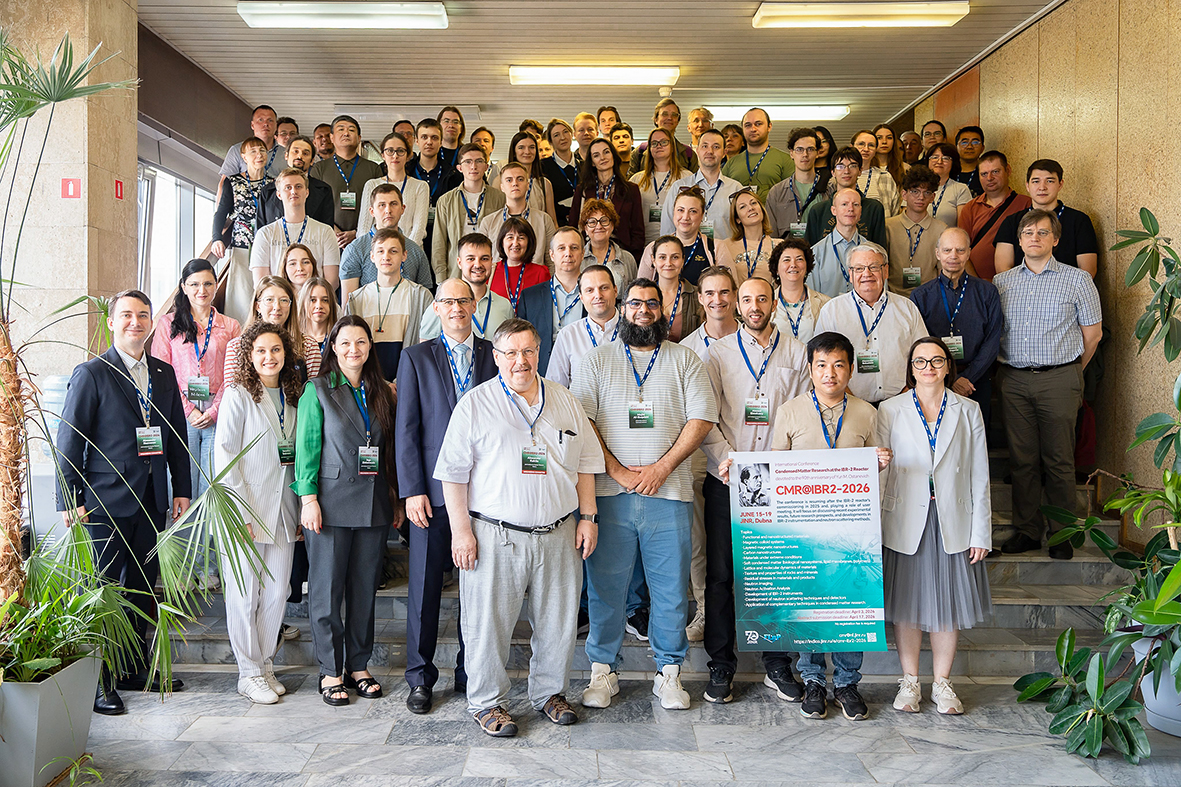
On 15 – 19 June, the International Conference on Condensed Matter Research at the IBR-2 reactor dedicated to the 90th anniversary of Yuri M. Ostanevich (CMR@IBR2-2026) was held in Dubna. The task of the Conference was the discussion of the latest experimental results, prospects for future research, the development of new instruments for IBR-2 and neutron scattering techniques.
The Conference was attended by about 150 specialists from Armenia, Hungary, Vietnam, Egypt, Kazakhstan, Mongolia, Russia, Serbia and JINR. The oral reports and posters presented the results of investigations in various fields: from research of functional and nanostructured materials, magnetic colloidal systems, carbon nanostructures to the research of soft condensed matter, rock and material textures, neutron imaging, as well as in the development of instruments for IBR-2, neutron scattering techniques and detectors.
Grigory Trubnikov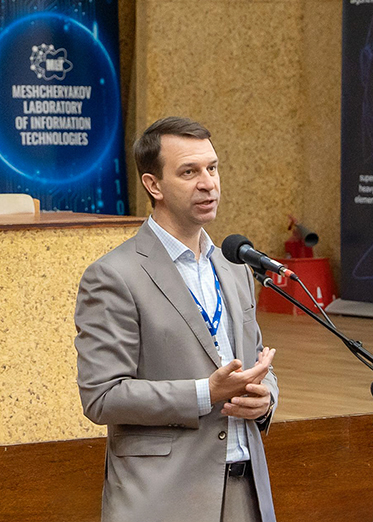
Egor Lychagin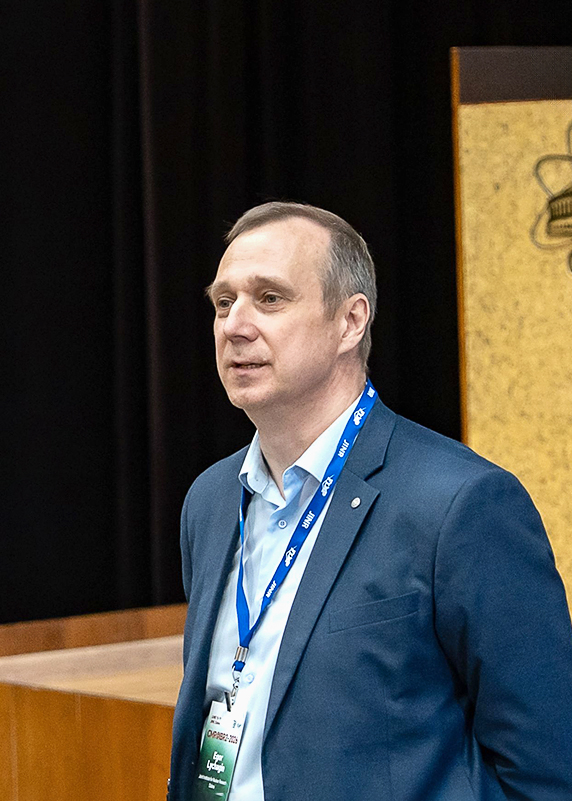
The report "Yu. M. Ostanevich and science at FLNP" was given by the chief researcher at FLNP Anatoly M. Balagurov. He started with the history of the origin of condensed matter physics in the Laboratory - the organization of the Department and the development of a complex of spectrometers, as well as the role of Yuri Mechislavovich in this process. "Over the years, it has become increasingly obvious that his achievements were of high priority not only for the Laboratory and the Institute, but also for our country, for Russia," the speaker emphasized. He outlined the biography of Yu. M. Ostanevich, the history of the development of FLNP and its scientific programme in the 1960s. Yuri Ostanevich, a student at Moscow State University, was noticed by F. L. Shapiro that worked at FLNP and invited him to work here and later, involved him in research on the Mossbauer effect. Presented by Yu. M. Ostanevich Ph.D. thesis on applying this effect to the investigation of physical and chemical phenomena in condensed matter, the Scientific Council rated very highly and decided to immediately award him the degree of Doctor of Sciences. Fedor Lvovich called him the best physicist in the Laboratory. This investigation was also highly appreciated by the leading physicists of the USSR V.I. Goldansky and D.N. Zubarev.
Анатолий Балагуров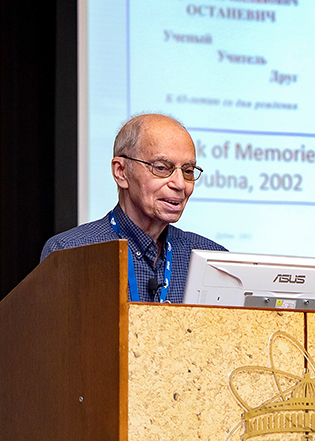
The number of scientific publications of Yu. M. Ostanevich is not very large - 115 articles for the period from 1959 to 1992 but each of them was deeply thought out and prepared. He was very careful about writing both his own and the articles of the Department staff. As an example, Anatoly Mikhailovich showed a scan of one of 16 pages of edits by Yu. M. Ostanevich that he had made about one of the articles given to him for reading. He recalled six international schools on neutron diffraction in Alushta, the programme of which under the section "Condensed Matter" had always been prepared by Yu. M. Ostanevich, the USA-USSR meeting on neutron scattering, successfully held at Brookhaven National Laboratory, the last conference on structural research on pulsed sources, largely prepared by Yu. M. Ostanevich and held in September 1992, in Dubna, but without Yuri Mechislavovich. Literally a month before its start, in the next kayak trip with family and friends along one of the northern rivers of Russia, Yu. M. Ostanevich died after an unexpected and very strong heart attack.
Vladimir Volkov (RNC "Kurchatov Institute") actively participated in the Conference:
- I am a specialist in the field of X-ray scattering, I have been engaged in neutrons, frankly, for a very short time. At the reactor near Hamburg, we examined the structure of the ribosome in solution. Using small-angle neutron scattering, we examined ribosomes directly in solution. To do it, Professor K. Nirhaus of the Berlin Protein Institute did a fantastic job of growing E. coli, which ribosomes were mined from, completely in a deuterated environment. Ribosomes are engaged in protein synthesis according to a given programme, reading it from RNA. The complexity of its work is absolutely cosmic, the ribosome consists of two RNAs and about 30 proteins and it was important to see how they are located relative to each other. With electron microscopy, due to the weak contrast, it was not understood. The ribosome is interesting in that it can self-assemble - you can collect its deuterated and protonated "bricks" from test tubes and "ask" it to assemble and it assembles into a fully functional ribosome. It doesn't matter if it is deuterated or protonated.
About 40 combinations of such samples were manufactured, almost 100 curves were taken at the neutron station near Hamburg and during the year, Dmitry Svergun, with some of my participation, processed them at the European Laboratory of Molecular Biology. Six months later, the group of Professor A. Yonat obtained crystals of the ribosome - after 40 years of attempts to crystallize it. Diffraction X-ray data was taken from them. These data contained about a million reflexes. They were processed for two years, it was an absolutely fantastic amount of work and the group gained an atomic structure, which they were awarded the Nobel Prize for. For this investigation, two Nobel Prizes could be awarded! We got a similar prototype six months before their publication but with a lower resolution. So, I learnt about neutrons, unfortunately, I wasn’t engaged in them anymore.
And what is your cooperation with the group of A.I. Kuklin today? Do you provide samples for research?
- It is based, rather, on data processing. The X-ray data that I shoot at my Institute and the neutron data of small-angle scattering that Alexander Ivanovich obtains here relate to disordered systems. Therefore, the solution to the inverse problem, how to get some structural information about an object from such data, is a solution, as mathematicians call it, to an ill-posed problem. In such problems, the slightest perturbation of the initial data from the test sample can result in unlimited distortions of the result. Therefore, it is necessary to use several techniques, the techniques themselves need to be stabilized, this is what we are discussing: how best and more properly to prepare the data for processing and in fact, how to build a processing scheme. I am a chemist by training, I work in physics, I am engaged in programming, that is, I come up with and develop algorithms for data processing.
You are a universal specialist!
- It helps very well because when physicists come and ask to measure something chemical, sometimes, you see that the sample has not been prepared quite properly. We have to explain how to do it and how not to, so as not to distort the structure of the sample. Being a chemist and carrying out an investigation of the structure using a physical technique is the best choice for a researcher, I think.
On the first day of the Conference, V. I. Borshchevsky (MIPT) delivered a report "Towards neutron crystallography of microbial rhodopsin":
- My report was dedicated to some future areas, about what you need to do to learn how to carry out an experiment on neutron crystallography at JINR. We know how to prepare samples for such experiments, we tried to implement it on IBR-2 and obtained diffraction spectra. So far, these data have been not very informative but they are and we should think ahead whether we wish to carry out further investigations, what is needed for it. From my point of view, we need improvements in the instrumental part, that is, to develop detectors, maybe to try to increase the neutron flux.
Cooperation with JINR has been active for quite some time, not only in the field of diffraction, but also in neutron scattering at small angles. We cooperate with the YUMO spectrometer almost constantly because neutron scattering experiments are implemented on it and we usually use X-rays in our experiments. These are two complementary techniques that are very good to use together.
You work in the Laboratory of V.I. Gordeliy at MIPT; he has been engaged in biological research at FLNP for many years.
- Yes, we do! We have a scientific centre at PhysTech, in which many people take part, including Valentin Ivanovich Gordeliy. We all work with him in this area.
Do you try to involve young people in cooperation with JINR?
- Of course, we do. In the experiment that we carried out in April, in addition to me and FLNP staff, our students and graduate students participated and graduate students also helped in the preparation of the sample at PhysTech. We have a lot of students, they are talented, actively involved in the investigation. It seems to me that many are impressed by the idea that you can study neutron diffraction: first, they learn at school that you can see light diffraction, afterwards, at the institute they learn that it is possible on X-ray and when they find out that there is neutron diffraction, it is very impressive and attracts people.
- V. Rogachev (MIPT/FLNP) discussed the future research areas with the colleagues:
- I came here as a third-year student in 2003 and here, I defended my thesis. Later, we began to widely develop this topic of the complementary use of neutrons and X-ray scattering at PhysTech, so our engagement in experiments, scientific topics with JINR widely develops. We are drawing colleagues from other institutions into collaborations and into the possibility of access to infrastructure complementary to neutron scattering, in a world where there are tools for synchrotron radiation, free electron lasers. We provide this access for the tasks that we have in FLNP, we also develop cooperation with colleagues from VBLHEP in synchrotron radiation.
You have not met Yuri Mechislavovich in the Laboratory. Is it important that the Laboratory had a foundation laid by such giants as I. M. Frank, F. L. Shapiro, Yu. M. Ostanevich?
- There are giants at any time. It is important to establish scientific schools and followers of these scientific schools because we are talking about consolidating competencies, about consolidating people, about developing a certain culture of scientific heritage. JINR has always developed such a story that the Institute has attracted scientific leaders that developed a scientific "flock" around them but everyone in it had their own opinions and understanding. So, we discussed low-angle scattering and Yuri Mechislavovich that was the founder of small neutron angles in Dubna, yet the instrument and technique have changed a lot since then. It has changed due to those scientists that adopted this heritage. If we are talking about the Soviet scientific and technological backlog and today, we see them in specific applied results, this is one thing. And here, we are talking about the fact that they do not live on the groundwork but on new techniques and technologies that were based on a scientific school. At the IBR-2 reactor, we just see such development. It fundamentally distinguishes both people and scientific schools that were established at JINR by such people as Yuri Mechislavovich Ostanevich.
- A. Saprykina (Institute of Archeology of the Russian Academy of Sciences) spoke about new discoveries made during the investigation of the results of archaeological excavations for more than ten years:
- Yes, this is a general overview of the investigations that we carried out at the first stages of major research and the work that we have done over the past three to four years. Neutron tomography and radiography for us turned out to be a kind of breakthrough technique. It allows you to meet some local problems, that is, to see how the object was made, from colored or precious metal. Especially, if we came across it as a whole during excavations and we strive to preserve its archaeological integrity. This technique allows us, without any destruction, to see how it was made, its internal cavities, internal defects, to estimate the safety of the metal that greatly helps in further restoration work. This is one layer. And the second is the investigation of mass material using mass flow method. For instance, when we study ceramics, we do not study a fragment of it but a series of one type or one chronological period we study with a combination of neutron tomography and diffraction techniques and other analytical techniques. And on this statistical sample, we look at how ceramics in their mineral and physical properties correlates with our archaeological technologies and thus, accumulate the volume of material, knowledge and skills in methodological approaches and a combination of various analytical research techniques.
Interesting samples from excavations were presented in your report.
- Yes, for example, ancient Russian jewelry (colts) were found by our employees during the excavations of the Tver Kremlin under A. N. Khokhlov (Tver). He provided us with several samples from the richest Old Russian treasure found on the territory of Tver. We studied this treasure in addition to standard analytical techniques, that is, X-ray fluorescence, optical microscopy, scanning electron microscopy, also using neutron tomography and diffraction techniques, precisely to look at some samples, such as a radial colt, for instance. It was not entirely clear how it had been made, we saw fragments but did not understand its design.
Can we say that these techniques allow one to understand the production technology?
- Yes! We saw the so-called stiffening rings that the colt was articulated from separate small parts.
And the neutron diffraction showed that silver of completely different composition was used there. And today, we assume that it was not a manufacture for a specific customer, but some mass production. Since miraculously preserved samples have reached us, we do not know how great the effective demand was, what the volume of production was. These investigations allow us to start looking at the material a little differently and interpret the data obtained from several points of view.
It turns out that this is not only an analysis of the chemical composition of the product and its structure, but also in some way, social and economic?
- We can already assume some other explanations. We get some data that allows us to start discussing other assumptions and other interpretations.
Next to yours, the report of B. A. Bakirov (FLNP/IA RAS) "New algorithms for neutron imaging" was given, he attracts neural networks to these techniques.
–Exactly. When we began to study massively archaeological samples, the volume of research started to increase significantly. And the question arose, how to speed up the process of processing the analytical data that colleagues obtain on the reactor using neutron tomography and radiography techniques? How to get the result quickly and efficiently? Bulat meets this problem. It often happens with us that the metal of the sample is degraded, we lose half of the information, if not more. Bulat tries to recover what can be "caught", saved and pulled. This is a very difficult task but it seems to me, according to the data that I presented - samples of iron weapons, this is the investigation of Bulat and Veronika Smirnova (FLNP); they managed to pull out information and show the degree of iron degradation, to find areas of preserved, so-called, living, that is, suitable for further analytical research iron and to try to reconstruct the technology in areas of very poor preservation. It is clear that we cannot talk about it with absolute certainty but from the traces that our colleagues managed to restore using their new technique, we can assume that it was batch welding or we see traces of forging and pulling metal. Alexander Kuklin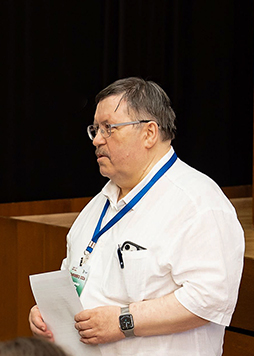
"Any conference is unique, despite the regularity and sequence," Chairman of the Organizing Committee Alexander Kuklin summed up the results of the Conference. “So, the Conference was dedicated to both the 70th anniversary of the Institute and the 90th anniversary of the birth of Yuri Mechislavovich Ostanevich, one of the founders of condensed matter research. This is the fourth Conference dedicated to an outstanding scientist and person. The topic CMR2026 is expanded; earlier, we focused on only one technique - the small-angle scattering. The current Conference is broader in techniques, areas and participants. Many outstanding reports were presented by young scientists at a good high professional level. The topical range was very wide: from magnetic structures, polymers, biological objects, crystals, including under special conditions, methodological developments to investigations of historical artifacts of cultural heritage.
Taking this opportunity, I thank Directorates of FLNP and JINR for the attention and support of the Conference, Directorate of MLIT for providing the opportunity to use the infrastructure, the JINR Service and the Organizing Committee of the Conference for informal and very active and proactive participation in the Conference. Special thanks to the Conference Secretary Tatyana Murugova, Veronika Smirnova, Alexander Ivankov and all the members of the Organizing Committee, as well as to the participants and speakers at the Conference."
Olga TARANTINA,
Photos by Igor LAPENKO
and Olesya CHEPURCHENKO
Based on materials from the JINR Weekly