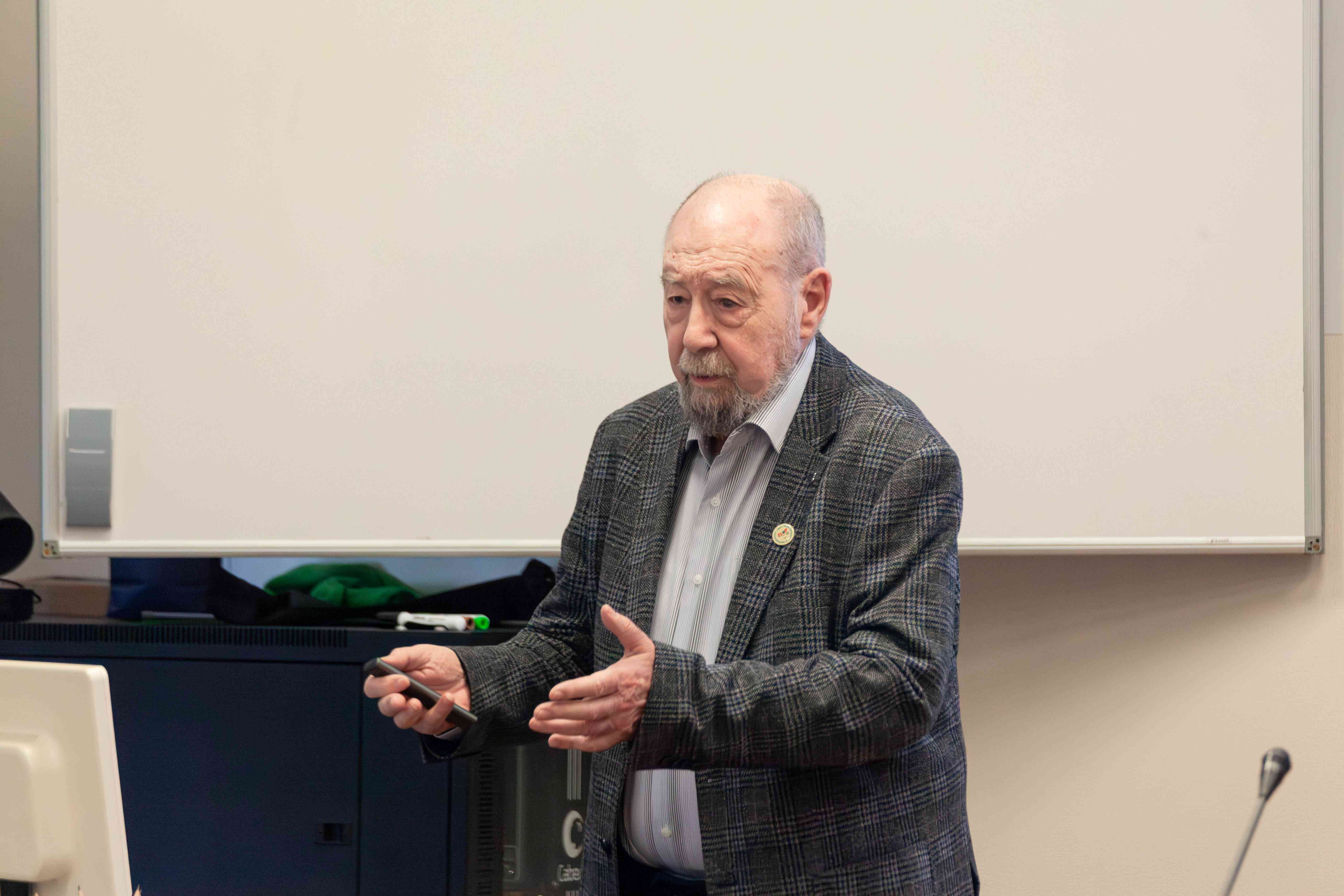
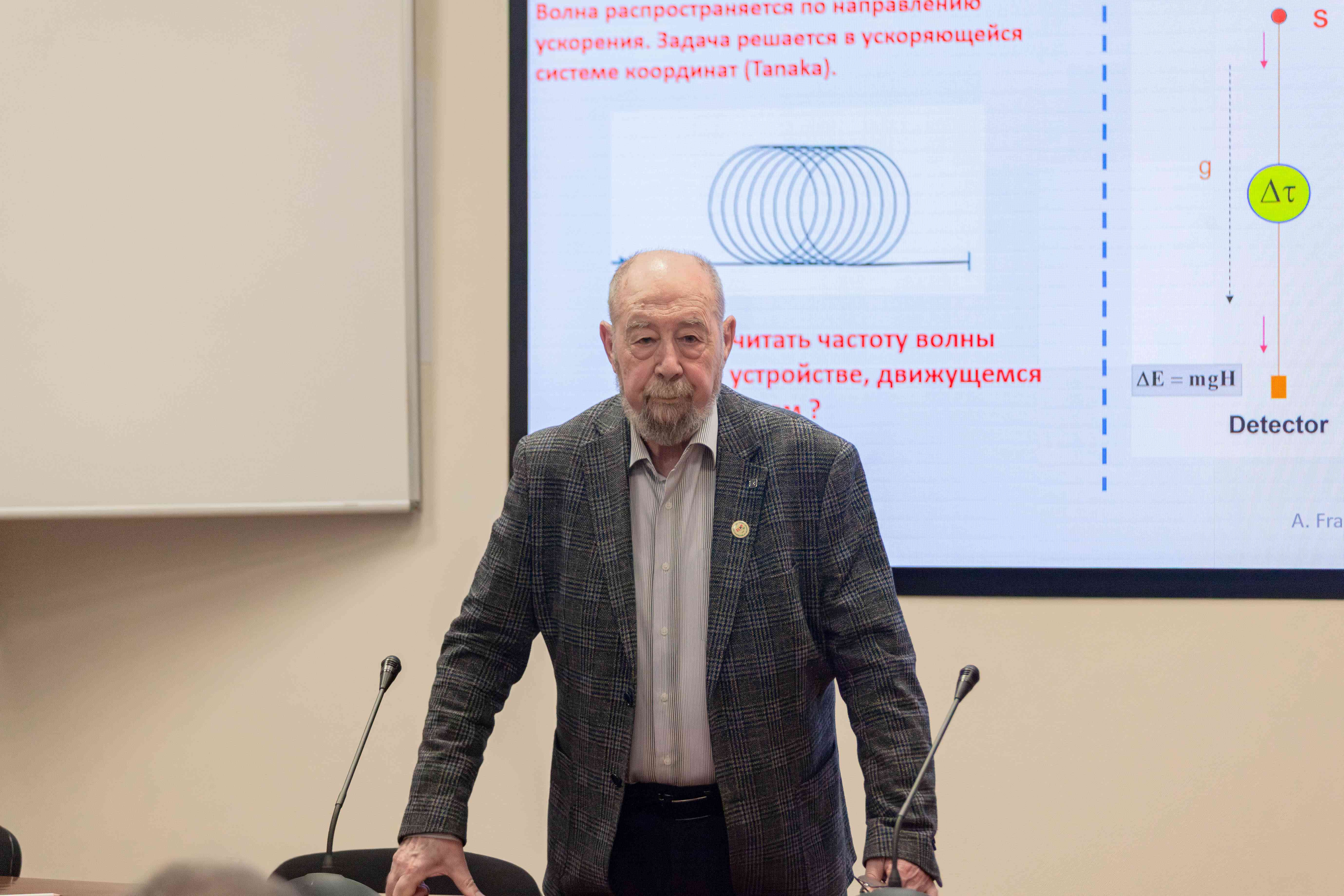
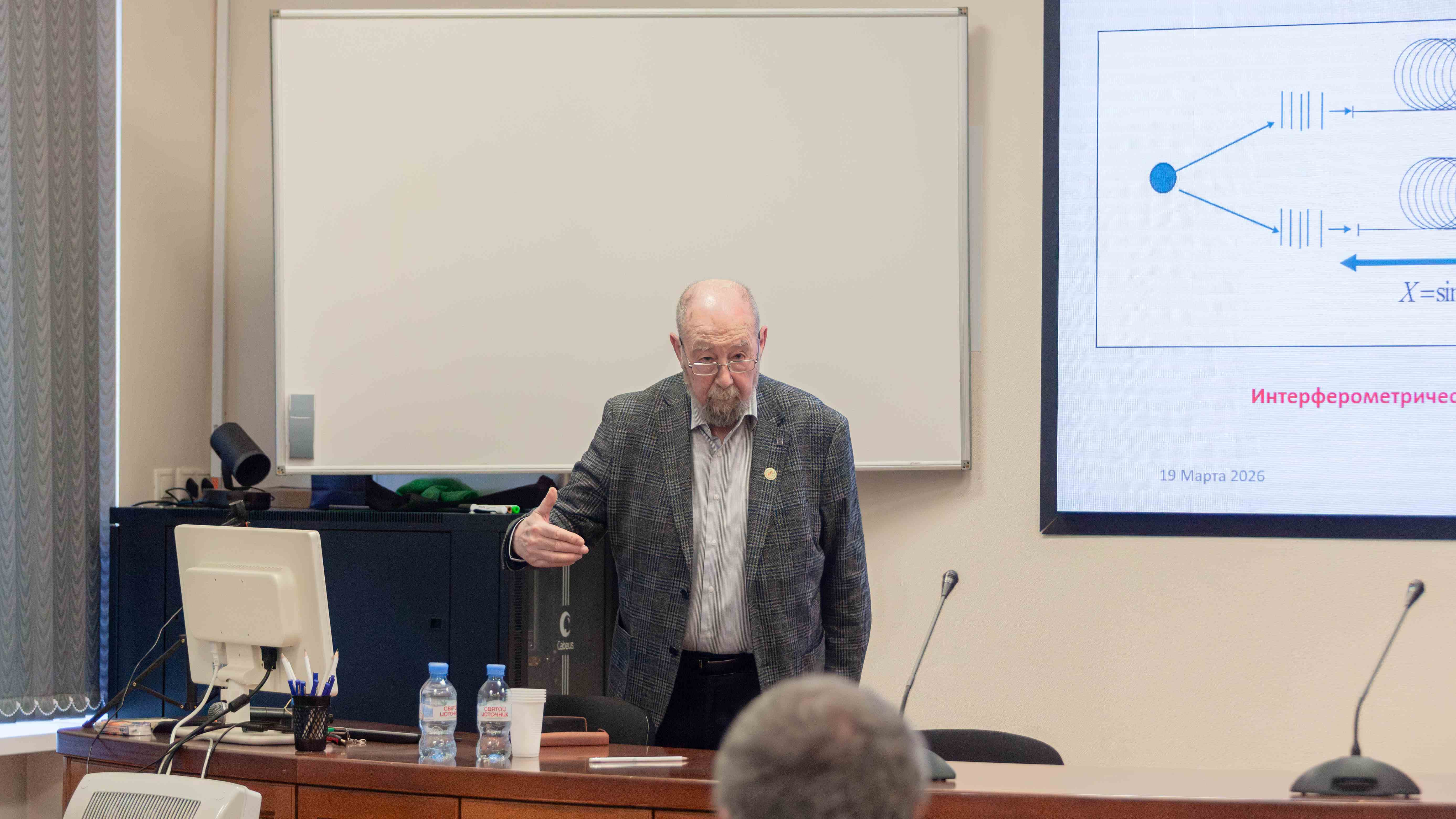
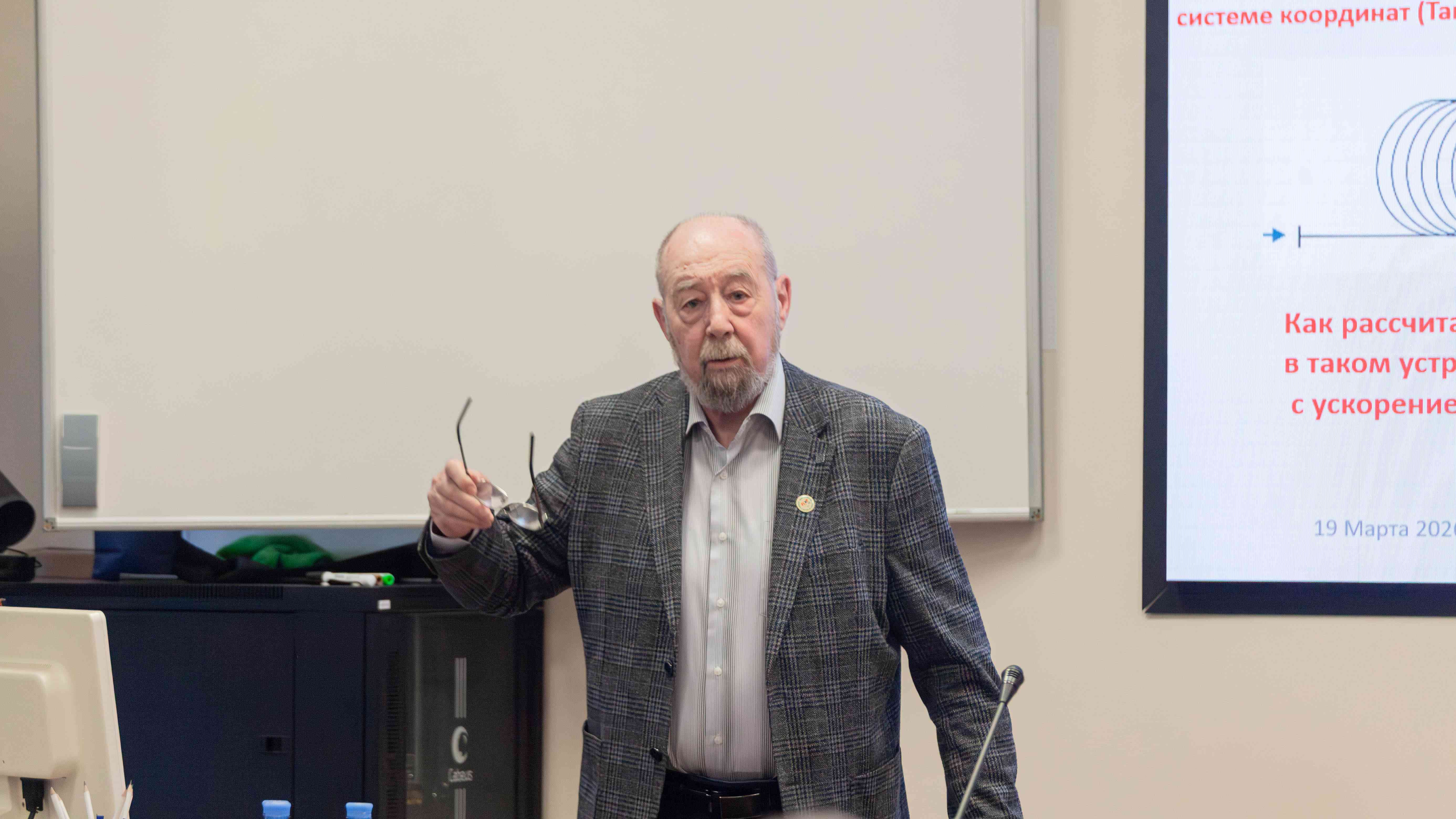
The seminar was the continuation of the speaker's series of reports in DNP FLNP.
We propose an experiment...
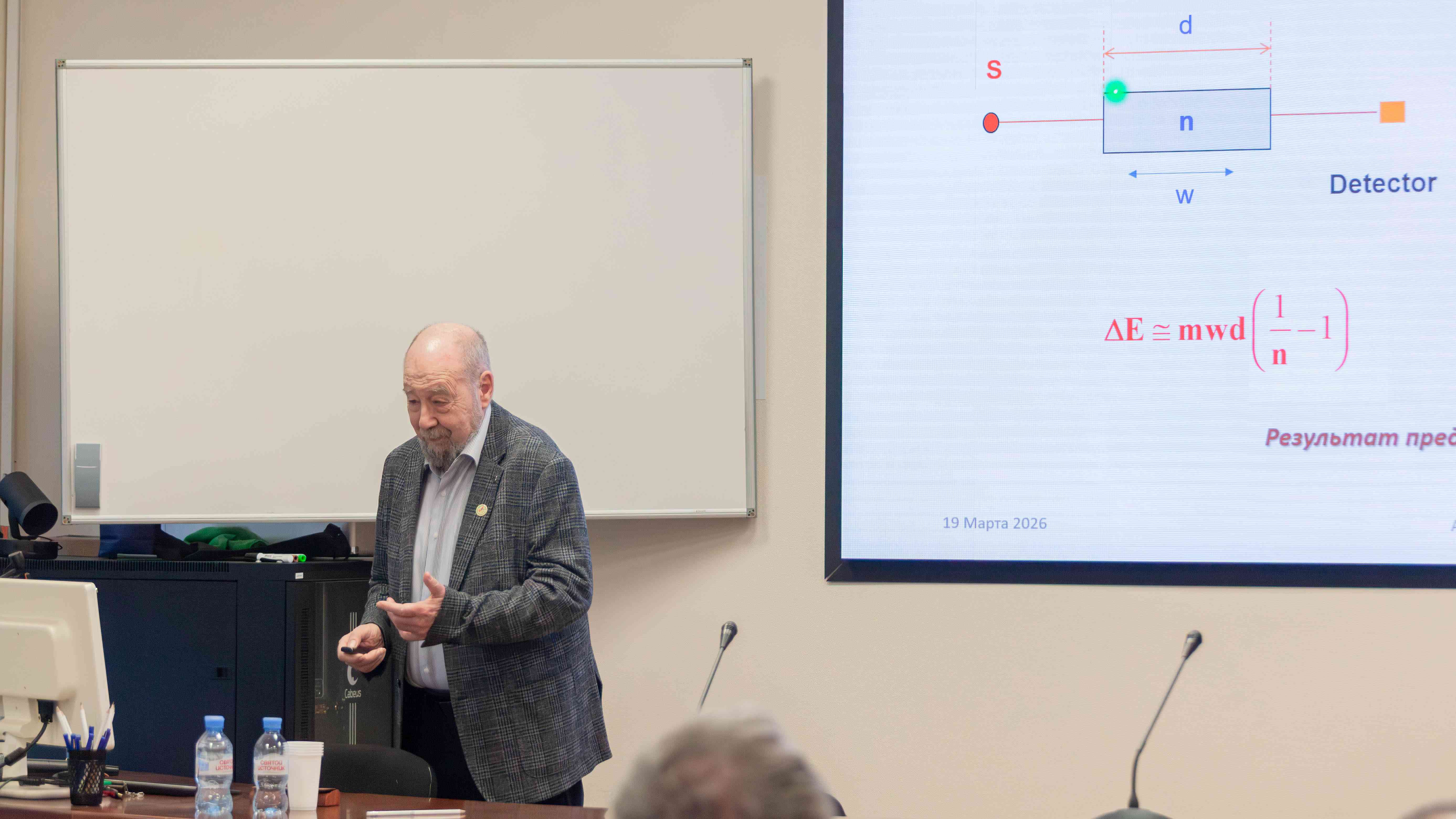
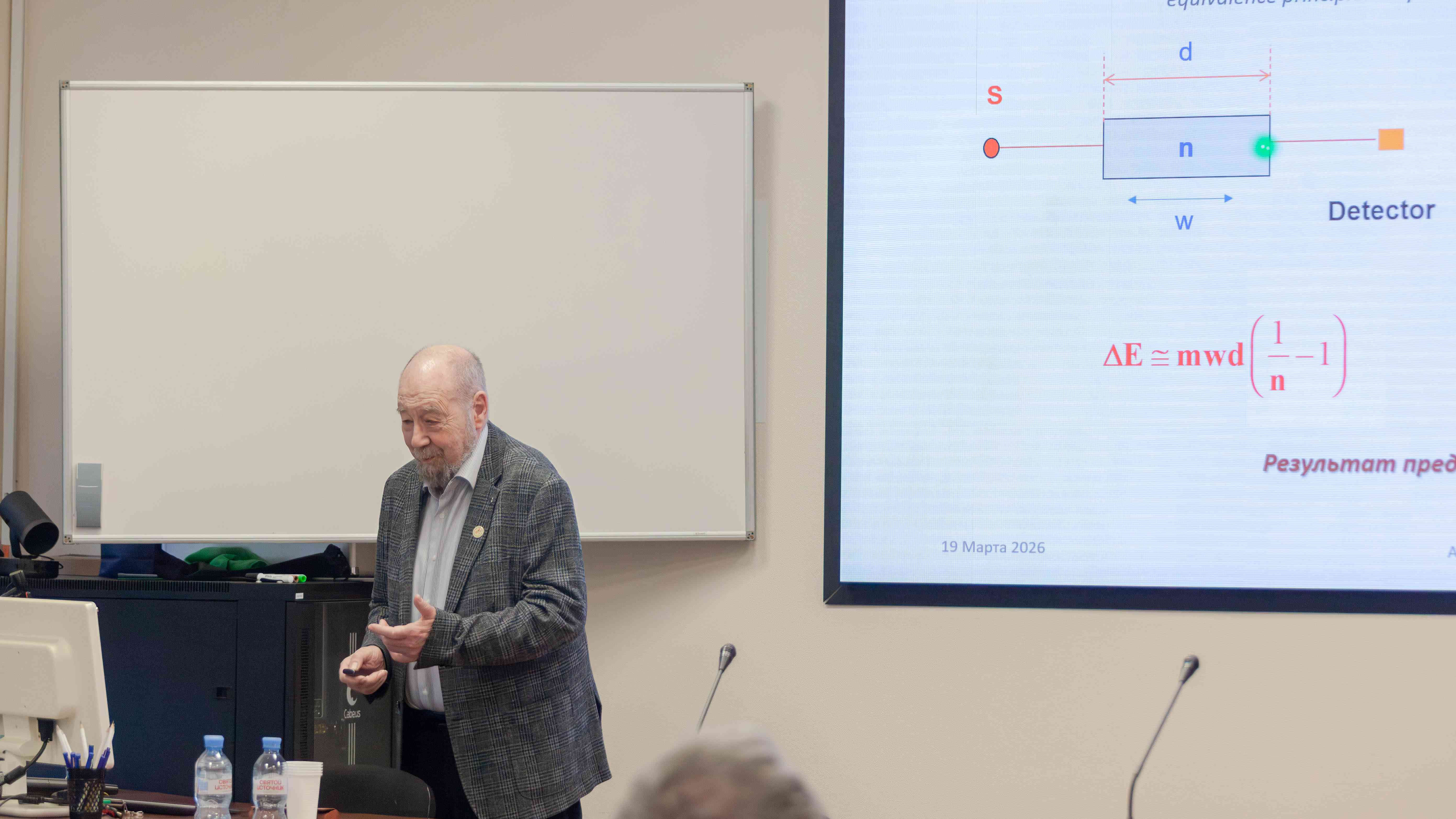
Several years ago, Alexander Frank showed that one of the consequences of the fundamental equivalence principle is the so-called acceleration effect. In accordance with this effect, any object scattering a wave or transmitting a narrow-band signal inevitably changes the frequency of the wave if it is moving with acceleration. The effect of changing the energy of a neutron passing through a refracting sample with acceleration was predicted by F. Kowalski in 1993. As the speaker emphasized, the result seemed paradoxical, yet the investigation was hardly noticed.
Later, the result of Kowalski was confirmed twice in the investigations of the employees of the Kurchatov Institute and ITEP, wherein, in the latter case, using a quantum approach. In addition, it has been shown to be consistent with the notion of a universal acceleration effect.
In 2007-2008, Alexander Frank and colleagues carried out two experiments to test the acceleration effect when a wave is passing through a refracting sample moving with acceleration at an ultracold neutron source at the Laue-Langevin Institute (France). Three years later, colleagues at the PNPI implemented a complex experiment with cold neutrons passing through an accelerating crystal near Bragg conditions. In the experiment, a change in neutron energy was registered and a time delay was observed that should occur. As the speaker highlighted, these experiments show that when passing through a crystal moving with acceleration, the frequency of the wave changes.
Considering the acceleration effect in neutron optics, Alexander Frank highlighted that the results of three experiments carried out are consistent with theoretical predictions. The acceleration effect can occur in classical physics, neutron optics, electrodynamics (light), in the optics of ultrarelativistic particles (neutrinos), quantum mechanics (scattering on a quantum object). The speaker expressed the hope that on the beamline that has recently started to be constructed on the IBR-2 reactor, it will be possible to implement some experiments in this area.
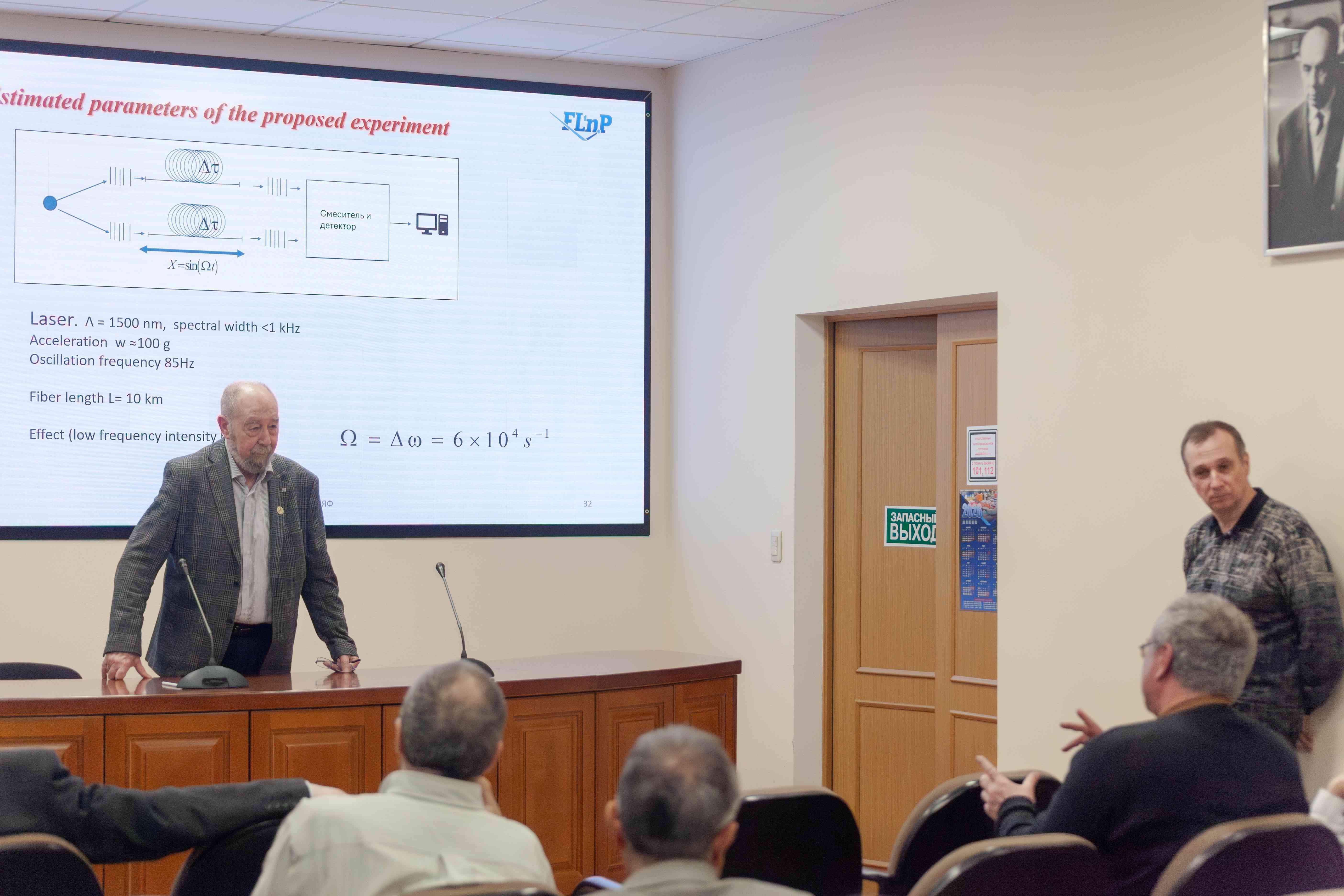
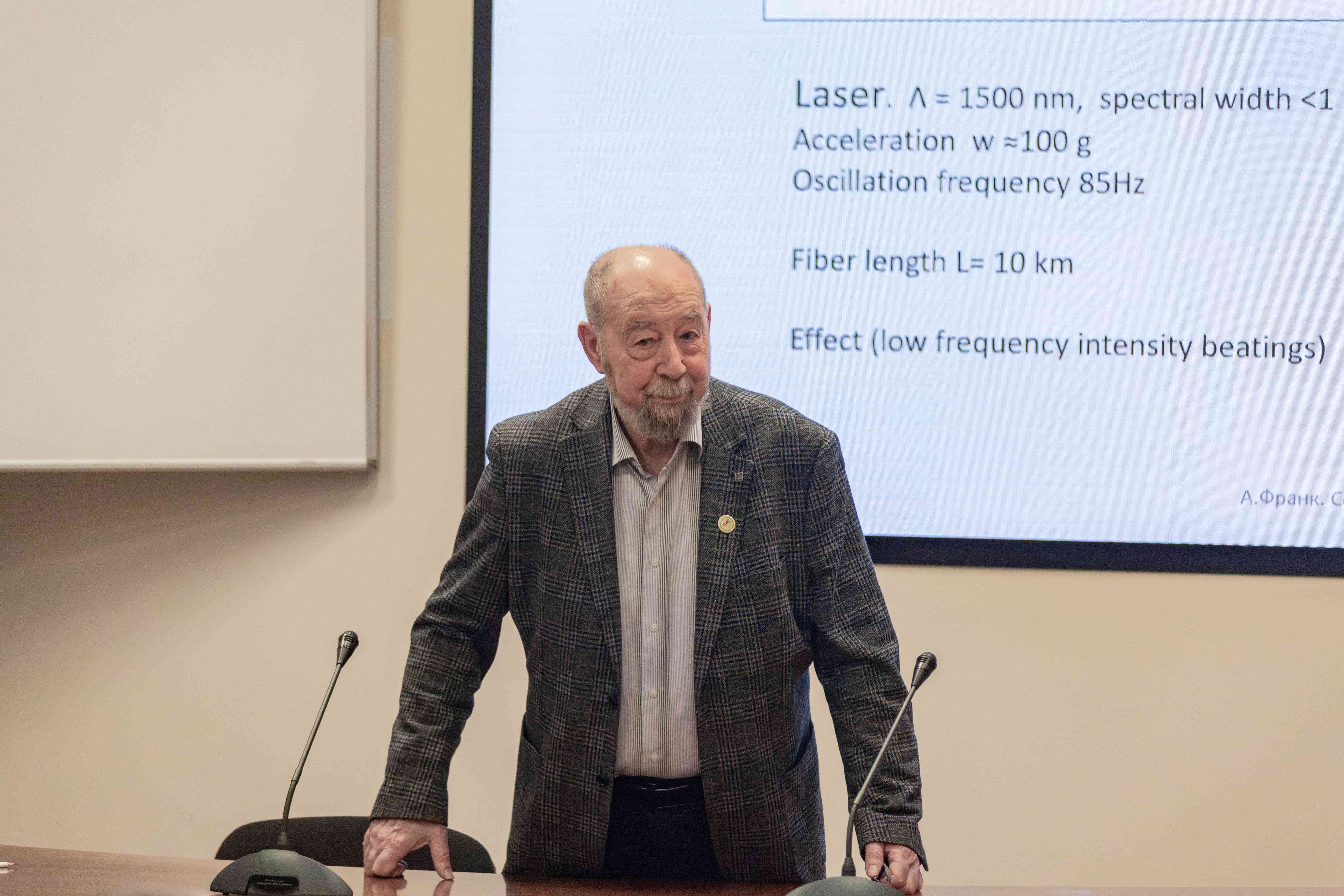
Another historical excursion by A. I. Frank was dedicated to Kazuo Tanaka that in 1982, met the problem of the passage of an electromagnetic wave through a dielectric plate moving with acceleration. His investigation had neither attracted much notice, as he himself believed that he had obtained the Doppler difference effect for light. The optical Tanaka effect is a special case of the acceleration effect, it has never been observed experimentally. In 2019-2020, A.I. Frank, together with G.V. Kulin and G.M. Arzumanyan, proposed an experiment using fiber optic cable to demonstrate the acceleration effect in optics. It will be a new test of the equivalence principle. The speaker presented the parameters of the experiment, evaluating it as "quite realistic and undoubtedly essential". "We propose an experiment for the first demonstration of the acceleration effect in optics," Alexander Frank said, concluding his speech. "It has to demonstrate the validity of the equivalence principle in a new area."
The report raised numerous questions from the interested staff members of the Laboratory gathered in the Conference Hall.
Olga Tarantina,
Photo by Alexander Ovodov, FLNP
Translated by Yelena Voskanyan