A leading researcher at FLNP Maria BALASOIU (Romania) delivered a scientific report "Investigations of the structural properties of carbon fibers obtained from waste and their potential use" at the late June meeting of the PAC for Condensed Matter Physics. Today, she will introduce our readers to this investigation.
- We are in a long-standing cooperation with the Institute of Technical Chemistry (ITC) of the Ural Branch of the Russian Academy of Sciences in Perm. I turned to them many years ago when I was looking for ferrofluid for our research at JINR. We needed more liquid and they knew how to produce it. Later, we turned to ITC again, we developed good relations and subsequently, I was offered to participate in the programme of the government of the Perm Territory "International Research Group (IRG)". I agreed and our first joint project was dedicated to ferrofluids. I will clarify that this object has very specific properties and up to this point, we have been engaged in ferrofluids with spherical particles.
The goal of the project was to produce ferrofluids with anisometric nanoparticles. In them, anisotropy in the magnetic field occurs not due to the alignment of particles into chains (like spherical ones), but due to the rotation and orientation of the anisometric particles themselves. The faster these ferrofluid particles in the thin layer are ordered, the better for applied use.
Ferrofluids have various physical properties, including, certain magnetic and optical properties that allow them to be used in optical modulators, sensors, diffraction gratings, phase modulators and magnetically controlled liquid lenses, as well as other devices.
In Perm, samples of ferrofluids were obtained: barium hexaferrite, these are very interesting plate particles, as well as rod-like particles of copper ferrite. It was found that in the case of anisometric plate particles, their magnetic and optical effect is much higher in velocity and intensity than the results with spherical nanoparticles and even with rod-like copper ferrite particles.
At JINR, we studied them at the SANS instruments (YUMO) and Small-angle X-ray scattering. In ferrofluids, particles are necessarily coated with a surfactant that is not visible in X-rays but is visible during neutron scattering. Using both radiations, we obtain both the properties of the surfactant layer and data about the size and shape of the particles, of possible aggregation. What is important, the Perm colleagues succeeded in obtaining stable ferrofluid with anisometric particles in water and it is really difficult, I know from my many years of experience working with the Romanian group. Why is water important here? It is not toxic, cheap to use, biocompatible with medical use.
In addition, in Perm, it was possible to find the best combination of three non-toxic surfactants that form a two-layer shell, covering and stabilizing anisometric and sufficiently large particles.
Do you still work in a joint project?
- This project has been completed but it has opened up great opportunities for us. Ferrofluid is an ideal system for neutron investigations, as it has magnetic properties that means that both its nuclear and magnetic structures are visible. It allows us to test the full potential of our techniques that is why we currently carry out these investigations.
For further development of our cooperation, our Perm colleagues invited us to take part in a new project within the framework of the same IRG programme - the production of composites based on ABS plastic with carbon fibers and magnetic particles. This research involves studying a system that surpasses all the systems I have previously studied in complexity.
In composites, fibers obtained by various processing techniques are used and it is important for colleagues from ITC to understand their properties in order to estimate and select the optimal processing technology for further use. For us, these investigations turned out to be non-trivial, currently, we figure out how to extract more data from measurements. I cannot but name my colleagues at FLNP that are engaged in these investigations. These are Alexander Ivankov, Olga Lis, Yulia Gorshkova, Akhmed Elmekavi, Anton Rutkauskas, Veronika Smirnova, Tatyana Vershinina, Sergey Kichanov.
Also, participation in this programme involves lecturing and for several years, I have been practicing in giving various lectures for ITC employees and students whom they involve in this investigation. Colleagues from Perm come to Dubna, participate in experiments, get involved into the methodology. We need to be confident in the reproducibility of the results and for this goal, we need to measure at least several samples of each type. And it is important to examine samples after different technological steps that are carried out in ITC. We have to understand what we can and see what we can't. Chemists start to understand what samples we need and we, in turn, need feedback and mutual understanding in our investigation for an optimal interpretation of the results.
In your report, there were slides with information about recycling, environmental benefits.
- The process of producing carbon fibers is very energy intensive, more energy consuming than removing fibers from waste and cleaning them. Savings range from 30 to 50 percent and this technique involves the use of waste and not the waste of natural resources. In Perm, the solvolysis process is used for it. Our results are very encouraging but it is necessary to collect statistics, you cannot draw conclusions from two or three results. For more detailed information on anisotropic systems, an important step in processing small-angle scattering data will be mastering the technique of extracting one-dimensional curves from two-dimensional images that depends on the azimuthal angle of the two-dimensional image. Next, we are going to involve neutron tomography to study the volumetric distribution of short carbon fibers in the composite material; however, the nanoparticles will be outside the resolution of the technique. Chemists are interested in the distribution of fibers, the degree of their orientation and factors affecting it, primarily, the rate of production of the matrix that affects the basic properties of the sample.
We traditionally receive invitations to chemical conferences from ITC. Our collaboration continues and while there is still much work to be done, it is inspiring, especially, when we get confirmation of our hypotheses.
Your report was given in a very unusual format - picture slides.
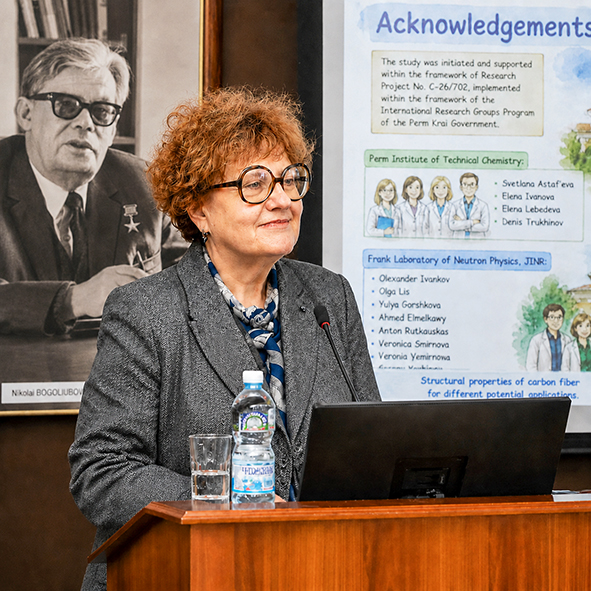
– I experiment with artificial intelligence to optimize certain tasks. For example, in this case, I asked the AI to depict the contents of my slides in pictures and it gave me such a result - I really liked it! My daughter helped me to start communicating with AI two years ago, she works in the IT field. Communication with AI is a very interesting process, I communicate with it very politely. And even when it turns out not quite what I wanted, AI offers to teach me how to ask it correctly in order to get the required result. The main thing here is to overcome your fear of the new.
Olga TARANTINA
Photo by Olesya CHEPURCHENKO
Based on materials from the JINR Weekly