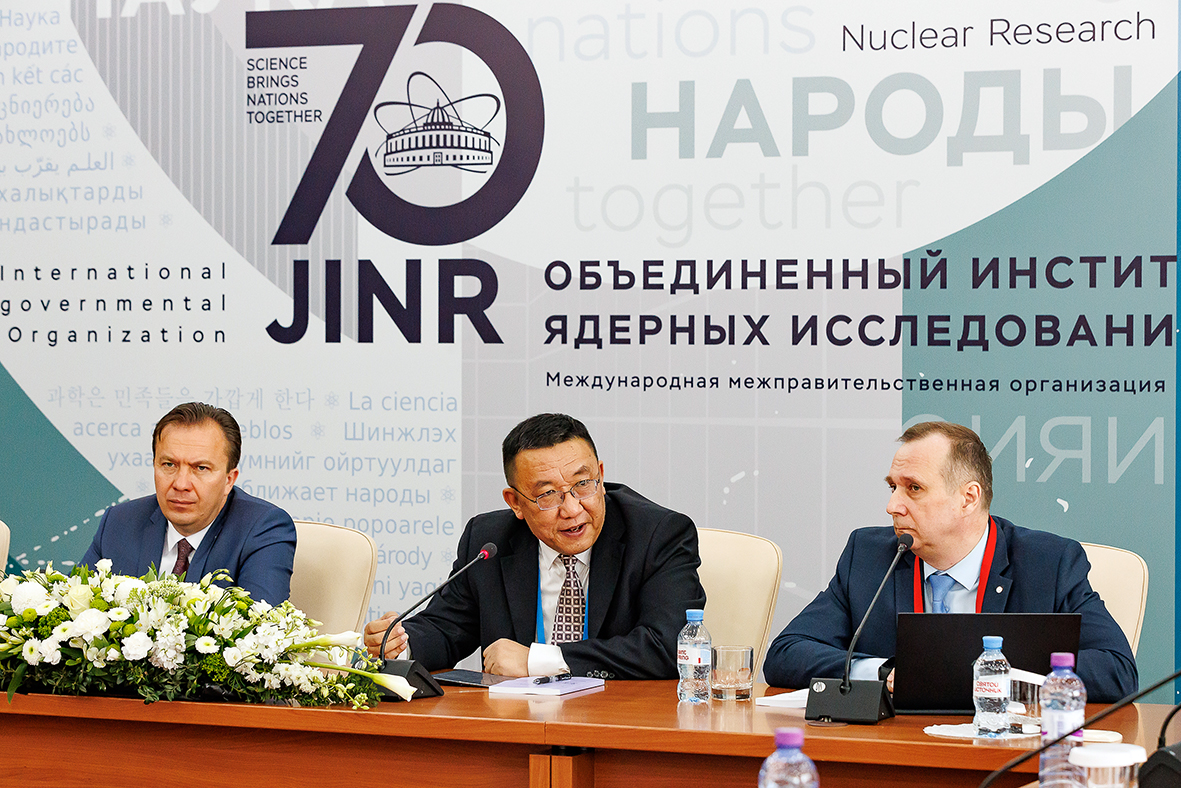
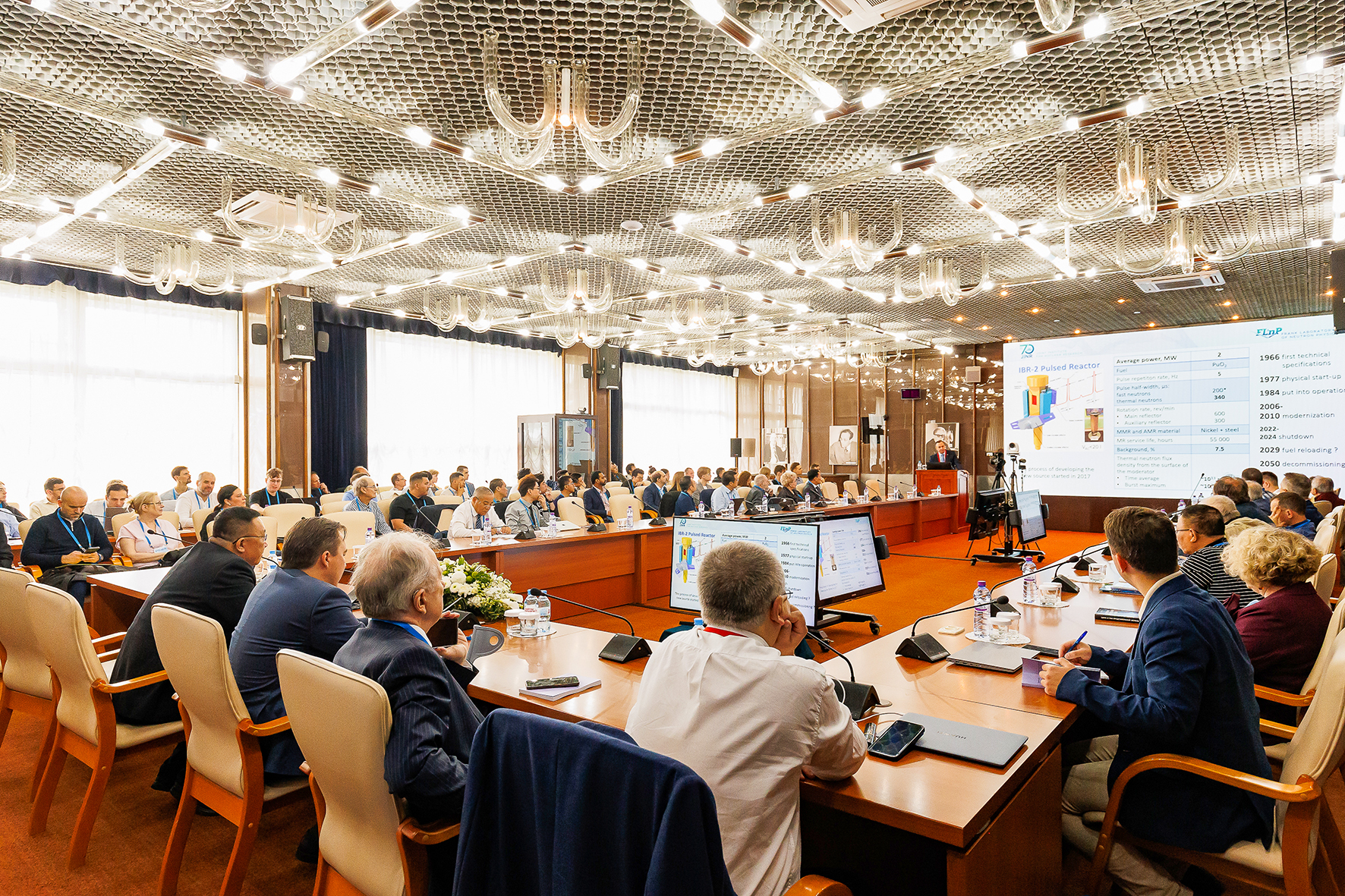
On 25 - 29 May, Dubna hosted the 32nd International Seminar on Interaction of Neutrons with Nuclei ISINN-32, organized by FLNP, the Chinese CSNS Centre and State Key Laboratory of Intense Pulsed Radiation Simulation and Effect NINT. More than 170 participants from FLNP, DLNP, BLTP, FLNR and VBLHEP, Bangladesh, Belarus, Vietnam, Dominican Republic, Egypt, India, China, Mongolia, Russia, Serbia, South Africa took part in it.
Traditionally, the subject of the Conference includes the fundamental properties of a neutron; fundamental interactions and symmetries in the neutron caused by reactions; nuclear fission; nuclear data for applied and scientific purposes; ultracold neutron physics (UCN); physics of nuclear reactors and other areas.
On the first day of the Conference, all participants were greeted by JINR Vice Director Sergey Kulikov that emphasized that ISINN has recently been held in different countries, but this year, Dubna again hospitably opened its doors. FLNP Director Egor Lychagin congratulated the Conference participants on an interesting programme and expressed the hope that communication would be successful, new contacts would be established. Deputy Director of CSNS (China) Liang Tianjiao that participates in this Conference with great pleasure, also welcomed the participants. In a greeting and his subsequent speech, he talked about new opportunities for users at China's CSNS neutron source and the next phase of its CSNS-II upgrade.
The first speech at the Conference was the report of Egor Lychagin "The current situation of the development of a new promising neutron source of FLNP JINR". I asked him to outline the highlights of this important report for the Laboratory and the Institute.
"The report consisted of two parts, although it was dedicated to the project of a new promising neutron source for JINR, I took half of it from the situation with the current source – the IBR-2 reactor” Egor Lychagin said. “From 2021 to 2024, we had a forced long stop due to the fact that we changed heat exchangers in the second sodium circuit, received a new license from Rostekhnadzor. Geopolitical events were superimposed on the situation that influenced the work of the factories preparing our new heat exchangers, as a result, the shutdown was longer.
The first point. After a long shutdown, the reactor was launched and operated for a year for the experiment. We earned on the same capacity at which we stopped - 1.5 MW, while we resumed the user programme: already in the second half of 2025 we collected applications, worked out applications in the first half of 2026 and collected for the second half of the year. According to statistics, we can say that the number of users has not decreased but they have been replaced: the number of proposed experiments from European countries has decreased but Egypt has been added as a new Member State, there is an active exchange with China - we go to experiments to them, Chinese scientists come to us. The ratio between the total number of Russian and our internal experiments to the number of external ones has been preserved. It makes us happy.
The second point. We have reached a good pace of attracting new users. For 2026, we registered 200 new users in our database, 200 researchers that had not previously used our services. For a year, it is good. Another issue and it worries us a little, is that three quarters of them are scientists from Russia. Therefore, we currently think how to attract more users from JINR Member States and Partner States that in the future may become Member States.
We also try to evaluate how long we can put the reactor into operation. The current license ends in early 2032. The extension of the reactor operation is based on three points: obtaining a new license; it is necessary that the equipment, the reactor can operate at a power; need appropriate personnel. Regarding the license: the regulator, according to the new regulations and rules, sets us the task - the security justification should be carried out using specialized computer programmes. The task is difficult, since before that we carried out all the calculations analytically and specialized programmes for IBR-2 were not developed. Most likely, we will not be able to implement this task on our own but last year, we began to cooperate with a large number of specialized organizations - the Research and Design Institute of Energy Engineering, the Institute for Safety Problems of Nuclear Energy Development of the Russian Academy of Sciences, the Scientific and Technical Centre for Nuclear and Radiation Safety, Physics and Energy Institute (Obninsk) and several other organizations with the help of which we hope to meet this problem and reach licensing. As our experience shows, it is advisable to submit documents a year and a half before the end of the current license, that is, by the end of 2030, we should collect the entire package.
As for technology. We have a list of equipment important for the operation of the reactor, for its safety that has a technical resource. And there is a rather routine task of extending the resource. There are more than 90 systems and equipment items on the list and there is a specific plan. What is critical? The reactor vessel in all parameters can be operated unchanged until 2050. The movable reflector, judging by how energy is currently generated, can probably be operated until 2032-2034, depending on what power we will operate at. What is important, we had a spare movable reflector manufactured seven years ago and in a year, we will be technically ready to replace if required.
The third is fuel. Due to fuel degradation, we are forced to constantly reduce power. The degradation process in the operating reactor scheme cannot be prevented or changed in any way, so the only way is to replace the fuel in order to, as it were, return to its original position. We will be able to return to a rated power of 2 MW and in seven years, we will begin to reduce it. We turned to JINR Directorate with a proposal to purchase a new fuel load for the reactor. The proposal was supported, funds allocated and a contract was awarded for the manufacture of a new fuel load. According to the contract, fuel should go to JINR in the first half of 2028, in the summer break of 2029 they could install it. At least, we will technically be ready.
Thus, according to the resources of the basic components, today, we see that technically the reactor could be operated until the end of the 2040s, having passed the license cycle two more times. Usually, a license is given for eight years, that is, until 2048, we could have a reactor as it is now. Replacing fuel, moving reflector, obtaining a license - you need to think carefully so that these events are scheduled at different times and to minimize reactor shutdown and work as much as possible for the experiment. We are engaged in it at present.
As for the new source. It is important that in 2024 NIKIET, when calculating the thermohydraulic properties of a reactor using neptunium fuel, I saw that it would be necessary to reduce the power of this reactor because temperature deformations cross the permissible limits. It is necessary to iteratively see how these parameters decrease with a decrease in power and at what power they will fit into the required tolerances. This is a long work, we are not engaged in it yet. We currently study the dynamics, since in the project “Neptun”, we have not agreed with the designers in what form the core should be assembled. Our physicists widely study the dynamics of pulsed reactors in general, trying to apply their prototypes to IBR-2 - the only operating reactor which these prototypes can be tested on, comparing the calculated values with those observed experimentally. Fortunately, we managed to interest NIKIET in this issue, they are included in the work.
In 2025, we slightly changed the approach to the ideology of developing a new source. Prior to it, the neutron flux density was indicated an order of magnitude higher than that of IBR-2 but it is already clear that achieving such parameters will require too many technical innovations. In reactor engineering, big steps forward are rarely taken. It is clear that it will result in a delay in the implementation of the project and probably, to an increase in its cost. We changed the logic a little, based on the fact that when the IBR-2 reactor was developed in the late 1970s, it had initially very high parameters - today's sources, even based on proton accelerators, only approach them. But at that time, the developers did not think much or did not have the ability to effectively extract neutrons, so if the designers and our physicists can offer a machine with parameters no worse than IBR-2, then we will try to improve the extraction efficiency by an order of magnitude due to advanced moderators and neutron optics and thereby increase neutron fluxes tenfold on samples in experimental facilities. In this case, such a project, it seems to me, will become interesting for our Member States and it can be implemented.
In 2025, NIKIET tried, retaining the ideology of IBR-2 - the principles of core layout, to see if it was possible to make such a reactor in today’s requirements. They did not succeed in the required fluxes that suggests that it is necessary to retreat in some technical solutions. In parallel with the project “Neptun”, a proposal was developed for a new promising plutonium-based reactor, in which the layout of the core differed from IBR-2 in that the controls were located inside the reactor vessel. This year, we asked NIKIET to see if this idea could be used and calculate what fluxes we could achieve. If they turn out to be commensurate or higher than that of IBR-2, then it seems to me that this will be a promising approach for a new reactor. And we, in turn, will simulate what neutron optics need to be developed, what reflectors, moderators, perhaps, choppers need to be used depending on the methodology of the experimental facility. We want to calculate, to be sure of factor 10, whether it can be implemented in practice.
We have an agreement with NIKIET until March 2027, so we will get the answer to the question whether it is possible to get the required fluxes in this layout that they currently consider. I hope that by this time, we will be able to simulate some kind of neutron facilities and neutron optics."
FLNP Scientific Secretary Alexander Nezvanov spoke to some of the Conference participants. First of all, he asked questions to Professor Liang Tianjiao (CSNS, Institute of High Energy Physics, China).
Liang Tianjiao 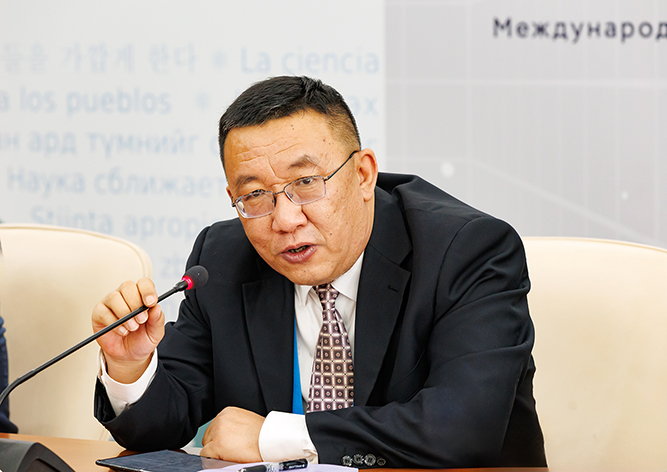
Since CSNS has been a co-organizer of this Conference for many years, how would you rate its level, the quality of the participants' reports, as well as the impact of this Conference on physics in China and on science, technology and physics in the world?
- I think that I first established contacts with FLNP employees in 2007, during the International Conference on Neutron Scattering. Afterwards, Sergey Kulikov took part in its work, today, he is Vice-Director of JINR. Then, as far as I remember, he worked on simulating a cold moderator and I did a similar task. At that meeting, we focused on the design and key neutron scattering technologies to construct the facility. Later, in 2016, I visited FLNP for the first time and took part in the ISINN-24. This Conference focuses on fundamental neutron research using such facilities. At the time, CSNS was still under construction.
I think there are two main topics in the scientific programme for IBR-2 and FLNP. One is neutron scattering for interdisciplinary sciences and the other is traditional: neutron physics and core structure. This is exactly the key topic of ISINN.
In 2016, only two institutes represented China at that seminar and only three people participated. However, as a result of this meeting, we established very close cooperation in the field of nuclear data measurement and research in the field of neutron physics. This time, about 20 people from China are participating in the Conference. Among them are not only representatives of CSNS, but also other institutes, for example, the Institute of Modern Physics of the Chinese Academy of Sciences, Peking University, Lanzhou University and other universities.
So, first of all, I think, this meeting is crucial for fundamental neutron research, nuclear structure research and nuclear data measurements. I think, it is a highly important conference on a global level. As for me, I myself do not directly work with nuclear data measurements but I have participated in many conferences on nuclear data in China. And the participants told me about the significance of this conference in their field. They hold their own conference on nuclear data, it seems, every four years, while ISINN is held annually. Therefore, I believe that this is a very relevant and required event in this area.
Two decades have passed since your first meeting with the colleagues from FLNP and about ten years - since your first participation in the ISINN Conference.
- At that time, CSNS was in the design and construction stage, so, we had little time for experimental research. But after the start of operation of our facility, we have had more common interests and today, we can cooperate more closely. I think it's a good opportunity for our young people. This time, we have about ten participants from CSNS. With the exception of me, the rest are about 30 to 40 years old, that is, they represent the younger generation. Only one or two of them have been to Dubna before, the rest are here for the first time. This is a good chance for them to establish a strong relationship and to cooperate with FLNP in the future.
What do you think about the current state of cooperation between FLNP and CSNS? What about the future, especially today, that the 2nd Phase of CSNS is launched? What areas of cooperation would you mark as the most promising?
- At the current stage, cooperation between CSNS and FLNP is focused, for instance, on nuclear data measurements, since our Back-n facility currently operates. In FLNP, the measurement of nuclear data has a very long history. Scientists from FLNP have already carried out more than three experiments on the Back-n facility at CSNS and I think there will be even more experiments in the future. Just yesterday, I met with several young researchers from Peking University. Today, they carry out experiments at FLNP.
Another relevant area is neutron scattering. With the support of both sides, we have developed a larger programme aimed at supporting cooperation in the field of cold moderators, as well as an ultracold neutron source. Other areas include neutron optics, neutron detectors and electronics, sample environment systems and neutron polarizers. These are all key technologies for neutron facilities.
However, I believe that the most important area is the practical use of neutron scattering. Since last year, researchers from FLNP have carried out over five experiments at CSNS. Recently, CSNS staff has also visited FLNP and has carried out an experiment on IBR-2. Therefore, I think that we can expand cooperation in the field of neutron scattering techniques. It's a vast area and we have a lot of complementary strengths. And one more point: as you know, we currently design and develop our ultracold neutron source, discussing future experiments at this source. FLNP is the cradle of the use of ultracold neutrons, you have a very long history and a rich experience in experiments with UCN. We look forward to closer cooperation in this area.
You are talking about promising areas in which we could not only start cooperation, but have already started it. Yet, what do you think about how to strengthen and deepen this collaboration with regard to the current scientific challenges? It may be necessary to develop administrative tools such as travel grants, to initiate joint funding applications, or something else.
- I think the first thing we need is to get to know each other better. As I have said, 20 years ago, I met Sergey Kulikov and 10 years later, we met again. Of course, we intersected at other international conferences. But I mean, both sides of cooperation should, first of all, know each other well: to know what you are doing, what I am doing and what our common interests are. In this case, we can form the basis for cooperation. We also need support from some funding body, for instance. Of course, we also need specific goals that will guide such cooperation. It means, more young people today come here and more young people from FLNP attend CSNS and carry out experiments on our facilities. It's a way to help people to understand and get to know each other better.
In your report on the UCN source at CSNS, I did not see a link to the main publication about it. Therefore, we would like to propose: if the CSNS group working on the UCN source prepares a conceptual technical report, a technical report or a joint article on the concept of the source, then these materials could be sent for publication in one of the scientific journals of JINR. As you have mentioned, given Dubna's scientific expertise in the field of UCN and international relations, I believe that such work will obviously allow you to receive useful feedback and comments from reviewers and readers.
- I agree with you. In fact, last year, we were going to organize a meeting on the use of UCN in May of this year. But due to some circumstances, of course, one of the reasons is that we are all very busy and have other commitments, this meeting has been postponed. In accordance with my plan, we would like to invite experts from FLNP. Perhaps, in winter, when we start organizing this meeting, I would like to invite friends and experts from FLNP to share their suggestions and comments. We may have many options for the first experiments. I think we will make a list, estimate the prioritization of different types of experiments and we will also need to identify the advantages and disadvantages of our source.
Since there are many UCN sources in the world, we need to ask ourselves the question: what is our advantage? What experiments should we carry out at the beginning of our source exploitation programme? I think that in all these issues, FLNP and JINR could help us a lot. And I would also like to cooperate more closely with experts from JINR and FLNP.
Thanks. Of course, I think it would be an honor for JINR and FLNP to take part in such an event. And we would be very happy to jointly consider a possible scientific programme for your source.
Corresponding Member of the Russian Academy of Sciences Anatoly Serebrov (PNPI, Gatchina) gave a report "Accurate investigation of neutron decay and the need to expand the Standard Model. Baryon and leptonic asymmetry of the Universe" on the first day of the Conference. Anatoly Serebrov has been participating in the Conference since the first years it has been held.
Anatoly Serebrov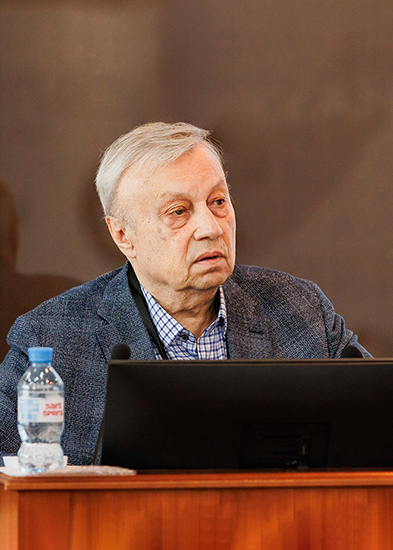
In Gatchina, under V. M. Lobashev, in the mid-1960s, the design of the first neutron source at the WWR-M reactor started. I graduated from the university in 1969, was engaged in this topic and with great pleasure study it today.
Since there was a reactor with a capacity of 18 MW in Gatchina, it was possible to obtain a greater intensity of UCN and we had to develop a beamline with a good density of UCN and a trap for their storage. Technically, it was not easy to meet these two problems in one technological complex of our Institute. Our grandiose source with a liquid hydrogen moderator in the centre of the reactor core was launched in 1986. The intensity of the neutron flux on it was comparable to the intensity of the high-flux ILL reactor (Grenoble). For ten years, together with FNLP, we have carried out an experiment on the storage of chemical substances and have achieved the best storage time. Afterwards, the difficult 1990s started, the operation of the liquid hydrogen neutron source had to be stopped in the late 1990s. The PNPI group carried out further experiments in Grenoble. There, in 2005, we got the best and most accurate neutron lifetime result in the world. The most interesting thing is that this result was in complete contradiction with what was written in the magazine “Particle Data Group”, by 6.5 standard deviations. It caused great distrust and at the same time, interest in the result. We proved our case with a new experiment with a UCN magnetic trap and for almost 20 years, our result has been the best. It has recently been confirmed in Los Alamos, measuring 2.5 times more accurately at the UCN in a magnetic trap and thereby, developing our magnetic experiment. The grandiose accuracy of measuring the neutron lifetime - 4 x 10⁻⁴ was achieved. The fact is that theoretically, the neutron lifetime and other coefficients of neutron decay asymmetries are calculated with the same accuracy that means that they can be compared within the framework of the Standard Model and thereby, to test it and to look for deviations from it.
Traditionally, it is believed that new physics is investigated on accelerators, in collisions of particles. Large staffs and great efforts are focused on them. It turns out, to our delight, that it is possible to identify whether there is a deviation or not by the "non-destructive" technique of alternative measurements. Recently, we have been able to identify a deviation from the Standard Model in the investigation of neutron decay asymmetries by a detailed analysis of neutron decay data. It turned out that one of the neutrino asymmetries in relation to the other differs by 3.7 sigma. It is already significant, so, we carried out an analysis what model it can be explained for, within the Standard it is not explained. Even at the first stages of developing the Standard Model, the left version of the interaction won, in simplified terms, due to the occurrence of only the left vector W-boson but at the same time, the classics said that there could be an admixture of the right W. We rethought this fairly ancient theoretical model and it turned out that the new is well forgotten old, only it needs to get engaged in. Indeed, within this model, we saw that there is mixing at the level of four percent. And surprisingly, the mass of the right W boson was evident at 300 GeV and it is 2.5 times more than the mass of the Higgs Boson. And in this model, the effect of CP violation, that is, violation of time reversibility, can be explained. It is the process of CP violations that is key in developing the universe. In the left-right asymmetric model that we propose, slightly changing the well-known model of the classics, it was only necessary to change the sign of the mixing angle of the right W with the left W depending on the sign of the charge of the W boson itself. This is the key point. Later, it turns out that the nature of CP violations becomes clear but it still needs to be proved experimentally. And from the clarity of the nature of CP violations, estimates are implemented for the baryon asymmetry of the Universe and oddly enough, we get those figures that are already known. The baryon asymmetry of the universe has already been measured.
What is the key task today? Firstly, neutron physics has got to such a level that it becomes responsible for the most relevant tasks of elementary particle physics, for the nature of the CP invariance violation and the far-reaching consequences of the origin of the Universe. After we have measured the neutron lifetime with great accuracy, experimenters need to make every effort to measure these asymmetries since it is there that we can "feel" the admixture of the right W to the left W. The accuracy of 3.7 sigma is not enough, it takes 5 or more sigma to finally believe in the model. Currently, it is the key task of the experiment in neutron physics. I think this topic will be one of the principal ones at the next conferences. And cooperation between Dubna and Gatchina, of course, will be carried out in the future. Here, on the IBR-2 reactor, a lot more can be done in pulsed mode. We need to understand whether it is possible to implement an experiment here to measure decay asymmetries - what we are doing now for the PIK reactor. The main thing is that a new task has occurred. When there are creatively passionate groups and you and I have the same fuse as at the beginning of cooperation and even young people have appeared that are our hope and new power, so, everything should work out."
Professor Ho Manh Dung (Centre for Nuclear Technologies, VINATOM, Vietnam) also shared his impressions with Alexander Nezvanov.
Professor Dung, I am very happy to see you in Dubna this year. This is not your first time participating in ISINN. I remember your wonderful talk and report at the last year's Conference in China. What do you think of the Dubna Conference?
Ho Manh Dung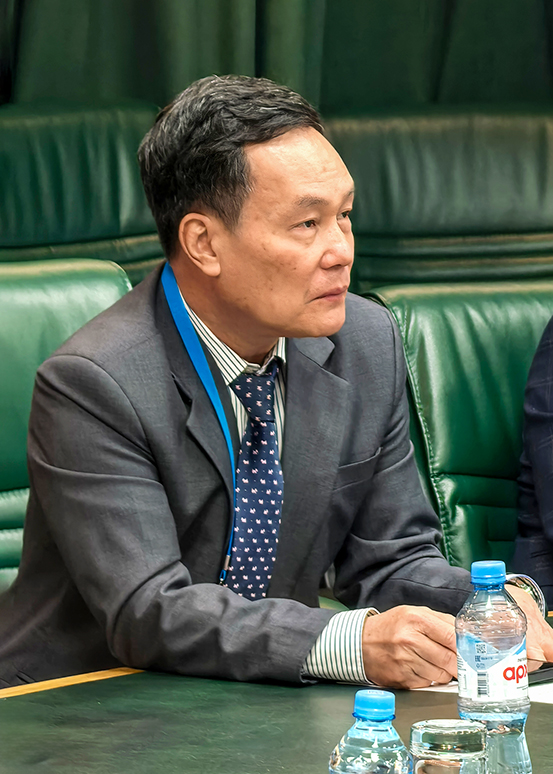
Thank you for your kind words. What do you think about the possibility of establishing effective scientific contacts with other participants within the framework of the Conference topics? I know that cooperation already develops between Inga Zinicovscaia, you and the institutions in Vietnam. Does the Conference serve to strengthen this cooperation?
–Yes, of course. Inga Zinicovscaia is engaged in Neutron Activation Analysis, just like my laboratory and we have long-standing scientific relations. We jointly publish some papers. Last year, we we were awarded the JINR Award for our joint investigations. We cooperate not only with colleagues from JINR, but also from other countries of the world. Some of them also participate in this Conference. And I hope that after ISINN, we will have the opportunity to strengthen cooperation between Vietnam and JINR, as well as with other countries. We want to send some talented Vietnamese students to Dubna where they can learn from your specialists. And we would also like to share the results of our research with colleagues from JINR in the framework of joint projects. I had some time out of the Conference yesterday and visited FLNP. It turned out that we have common scientific interests and we could cooperate in the future.
What would you advise the Organizing Committee of the Conference and FLNP?
- It is a very interesting question, since the ISINN Conference covers a very wide range of areas. So, if you ask me what area should be added to the subject of the Conference, then, since Vietnam is a small country and we do not have such large facilities as in Russia or China, if you add more applied areas, such as the use of nuclear physics techniques, it would be relevant for small countries. In Vietnam, nuclear medicine is used in many hospitals at present. This area is currently very developed and in demand with us. If you expand the topic, you can include, for example, a section on radiation safety. That would be very helpful for Vietnam. Many technologies are used in this area. We are talking about applied work, not fundamental research or work on nuclear data since fundamental research requires very large facilities and we do not have the ability to construct them. Therefore, we carry out only some fundamental research, focusing on their practical use.
I asked Chairman, Corresponding Member of the Russian Academy of Sciences V. P. Kolotov (V. I. Vernadsky Institute of Geochemistry and Analytical Chemistry) about the first report on the Section "Nuclear Analytical Techniques and Life Sciences": "M. V. Frontasyeva delivered an interesting retrospective-historical report on our Section "Milestones in the history of Neutron Activation Analysis - celebrating the 90th anniversary" in which the history of the development of Neutron Activation Analysis was summarized, starting with the discovery of radioactivity, the basic milestones are shown, what science was done during this time, pioneer work and people who stood at the origins of Neutron
Activation Analysis were highlighted. Marina Vladimirovna has done a great job, she has gathered everything together, somewhere found photos. This report should be published on the JINR website or the Laboratory website as it is interesting in itself.
We have long-standing relations with the NAA Sector, since the time of V. M. Nazarov. Marina Vladimirovna and today, her work is continued by Inga Zinicovscaia, they are engaged in a great and interesting job. In fact, unfortunately, it is the only group in Russia that widely works on the NAA. It was stated in the report that there were many centres and a series of meetings on the NAA were held; conferences on the use of nuclear techniques in related fields were held in Tashkent, Tbilisi, Moscow and Dubna, organized by Academician G.N. Flerov and later, by Yu. Ts. Oganessian. Our Institute started to cooperate with G. N. Flerov back in 1959, even earlier, when he still worked at the Laboratory of Measuring Instruments of the Academy of Sciences, where the first investigation on superheavy elements started. Dubna is a "prayed" place where the consolidation of work on activation analysis and the use of nuclear techniques is held. Researchers gathered here regularly, everyone knew each other. So - thanks to Dubna!"
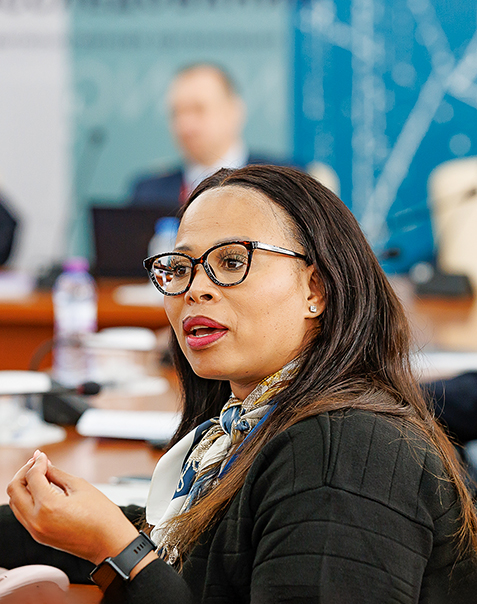
Zikhona Tywabi-Ngeva (Nelson Mandela University, South Africa) is participating in the Conference for the first time:
- Yes, this is my first ISINN Conference. I decided to take part in it mainly because I had a working relationship with FLNP. And it was very important for me to see some of the research that is carried out in the Laboratory. Obviously, coming here, I pursue my own specific scientific goals and objectives, so I am not yet very aware of what research is implemented at the Institute.
Does the Conference help to get a general idea of all research areas?
- Yes, no doubt. I am really impressed by the wide variety of research areas and the expertise within the Institute. I would also like to highlight that material science is very developed here. Thanks to the Conference, I have learned that there are quite a few devices and facilities available for various types of analysis of my materials. Therefore, I am incredibly impressed with both the depth of expertise and the availability of infrastructure for implementing various types of investigations.
Did you manage to find possible ways for new cooperation during the Conference?
- Yes, we exchange contacts and discuss cooperation with other participants. For example, I have already received two proposals for cooperation from colleagues from China. And for me, this is exactly the main goal of the Conference.
How do you think the Conference will be even more productive and successful, especially, in terms of creating effective conditions for communication between people and organizations, finding the use of various techniques in materials science and basic research, as well as developing cooperation between participants?
- I firmly believe that a new generation of researchers is moving towards a more communicative approach in science. By "communicative approach" I mean presenting the results of research in such a way that even an outsider can understand what the purpose of this project is. Therefore, perhaps, we should try to move away from presenting our research only in a strictly scientific format and instead, show how we have moved from theory to practice and what problems we are trying to meet. We need strategies to communicate our results so that even a person who has never worked in our field can clearly understand the impact our research will have on the economies of our countries or on the societies we serve.
The ISINN-32 was attended by two employees of the VINCA Institute of Nuclear Sciences (Belgrade, Serbia). Dushan Topalovich is sharing his impressions, "I am participating in this Conference for the first time and has visited Dubna for the first time. This is a great place, comfortable for scientists. We are very impressed with the organization of the Conference, the Institute itself. I am here not only because I participate in the Conference, but because our VINCA Institute is involved in a joint project with FLNP. I also participate in a collaboration with MLIT. Our project ends at the end of 2026 but I think we will start the next one and therefore, I will come to ISINN."
"I'm very happy to be here," Mirian Radenkovic added. “I think the Conference is going well. Many specialists met here to exchange their new knowledge gained in experiments. Participating in ISINN has been very beneficial to us."
Noha Nassar (Cairo University, Egypt) is participating in the Conference not for the first time: "Firstly, I want to thank the organizers for such a wonderful event. Secondly, it is very important for me to meet from time to time with colleagues to exchange information, to discuss new ideas and to open new projects. The scientists that participated in the work of my Section have very good publications that will be useful to me in my work. I am a postgraduate student at Cairo University. We use Neutron Activation Analysis for environmental investigations with biomonitor mosses. In this way, we study the pollution of industrial areas of Egypt, compare the data obtained with indicators in unpolluted places. We also do some statistical analysis to estimate the sources of industrial pollution."
A Letter of Gratitude to the organizers of the Conference was sent by Punit Dabi (Benares Hindu University, Varanasi, India), it says, "I appreciate as a privilege the opportunity to participate in the ISINN Conference. From online registration to arrival in Dubna, the organizers were constantly in touch and provided comprehensive support to all Conference participants. Its programme was compiled very professionally, all performances and poster sessions were held on time. The Conference considered a wide range of relevant topics related to neutron interaction, neutron detection techniques using liquid scintillators and other detector systems, as well as applications in fundamental nuclear physics, nuclear medicine, radiochemistry, Neutron Activation Analysis. Scientific discussions have been very informative and useful for young researchers like me. An interesting excursion and a wonderful picnic were organized.
I wish to highlight good catering during the whole Conference. As a vegetarian, I was particularly excited about enough vegetarian options. In general, participation in the Conference was an outstanding scientific and cultural experience for me. It was a great opportunity to learn from highly qualified specialists and to communicate with participants from different countries. Thanks to ISINN, I gained valuable information and expanded my research practice. Sincere thanks to the Organizing Committee of the Conference and the whole JINR staff for their hospitality and excellent organization. I will look forward to the opportunity to participate in the next events, to visit the Joint Institute again."
Alexander NEZVANOV, Olga TARANTINA,
Translated by Tatyana AVDEEVA,
Photos by Elena PUZYNINA and Igor LAPENKO
Based on materials from the JINR Weekly