In a new collaborative study, researchers from Frank Laboratory of Neutron Physics at JINR demonstrate how interface‑state resonances in a water‑immersed Pb/epoxy phononic crystal can be tuned through periodic acoustic‑impedance modulation and engineered triangular surface textures. Phononic crystals are periodic structures in which the elastic and acoustic properties are modulated, creating band gaps and localized modes in close analogy to multilayer neutron optical systems with periodic scattering‑length‑density contrast; by tailoring layer thicknesses and interface geometry, both platforms can guide, filter, and confine waves with high spectral selectivity.
JINR scientific team: Zaky A. Zaky and V. Zhaketov. 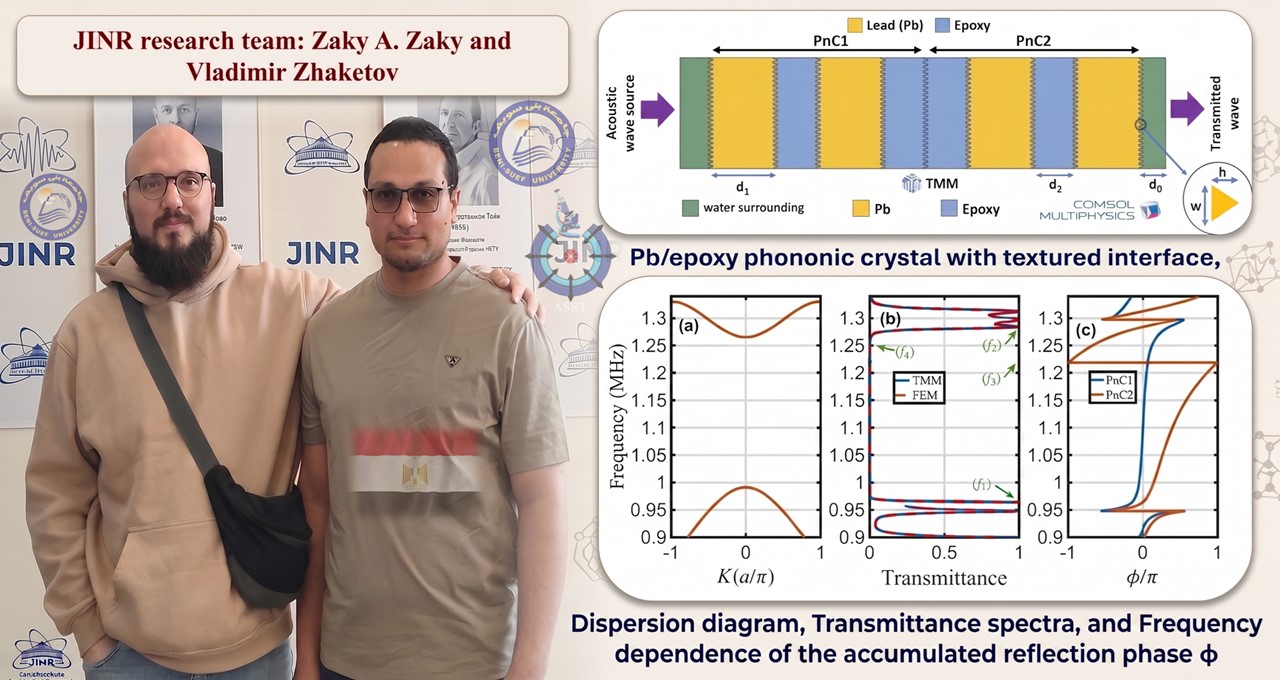
In the reported work, all internal Pb/epoxy interfaces are corrugated with triangular textures, and two mirror‑symmetric supercells are joined to host an interface‑state resonance inside the main band gap. A combination of transfer‑matrix modeling and finite‑element simulations shows how texture height and width, together with Pb and epoxy thicknesses and the number of unit cells, jointly control the resonance frequency, band‑gap width, and linewidth: moderate corrugations efficiently tune the interface mode while preserving a wide stop band and a narrow, high‑Q peak, whereas excessively deep or wide textures shrink the gap and broaden the resonance. These results establish textured interfaces as an independent and powerful design parameter for manipulating interface‑localized modes in solid–liquid phononic crystals, and they provide practical guidelines for compact underwater acoustic sensors based on robust, well‑isolated interface‑state resonances.
Top: Lead-epoxy phononic crystal with a ribbed interface.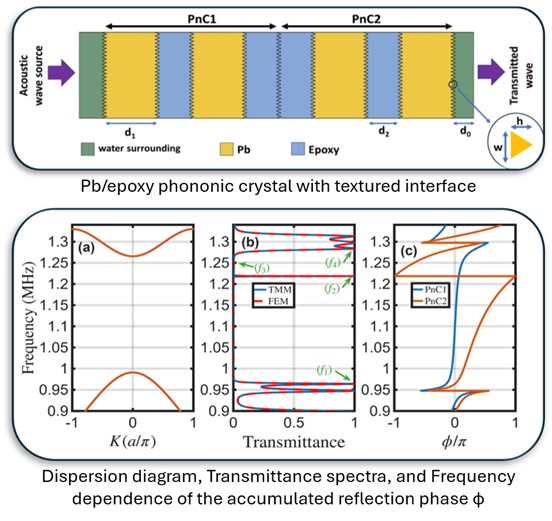
Bottom: Dispersion diagram, transmission spectra, and frequency dependence of the reflection phase shift ϕ.
Because the underlying mechanism; band‑structure engineering, phase crossing, and symmetry‑protected interface localization; is generic, the same design philosophy can be transferred to neutron optics, where periodic multilayers with tailored interface “texture” and contrast can support interface‑state modes for use in neutron filters, spin‑selective waveguides, and resilient elements in neutron guide systems. In this way, the study strengthens the conceptual link between acoustic and neutron wave control and illustrates how detailed interface engineering in phononic crystals can inspire new architectures for neutron‑optical devices at FLNP.
FLNP researcher Ibrahim Zaky Abdelslam Zaky “Our phononic crystal structure directly analogous to multilayer neutron systems with scattering‑length‑density contrast, and it shows how carefully textured interfaces can be used to create and tune robust interface‑state modes. This study has led us to extend the same interface-state concept to neutron filters, and our first neutron‑optical design based on these modes is already under review, highlighting the strong synergy between acoustic metamaterials and neutron optics.”
Reference:
Zaky, Zaky A., Ali Hennache, and V. D. Zhaketov. "Interface-state resonances tuned by layer thickness and surface texture in a Pb/epoxy phononic crystal." International Journal of Modern Physics B (2026): 2650190. https://doi.org/10.1142/S0217979226501900