A researcher at the Frank Laboratory of Neutron Physics at JINR Zaky Ibrahim demonstrated in a series of computational studies how a universal mathematical approach can enable the design of devices for manipulating waves of various natures. His work shows that concepts from photonics and acoustics could be the key to creating next-generation neutron optics.
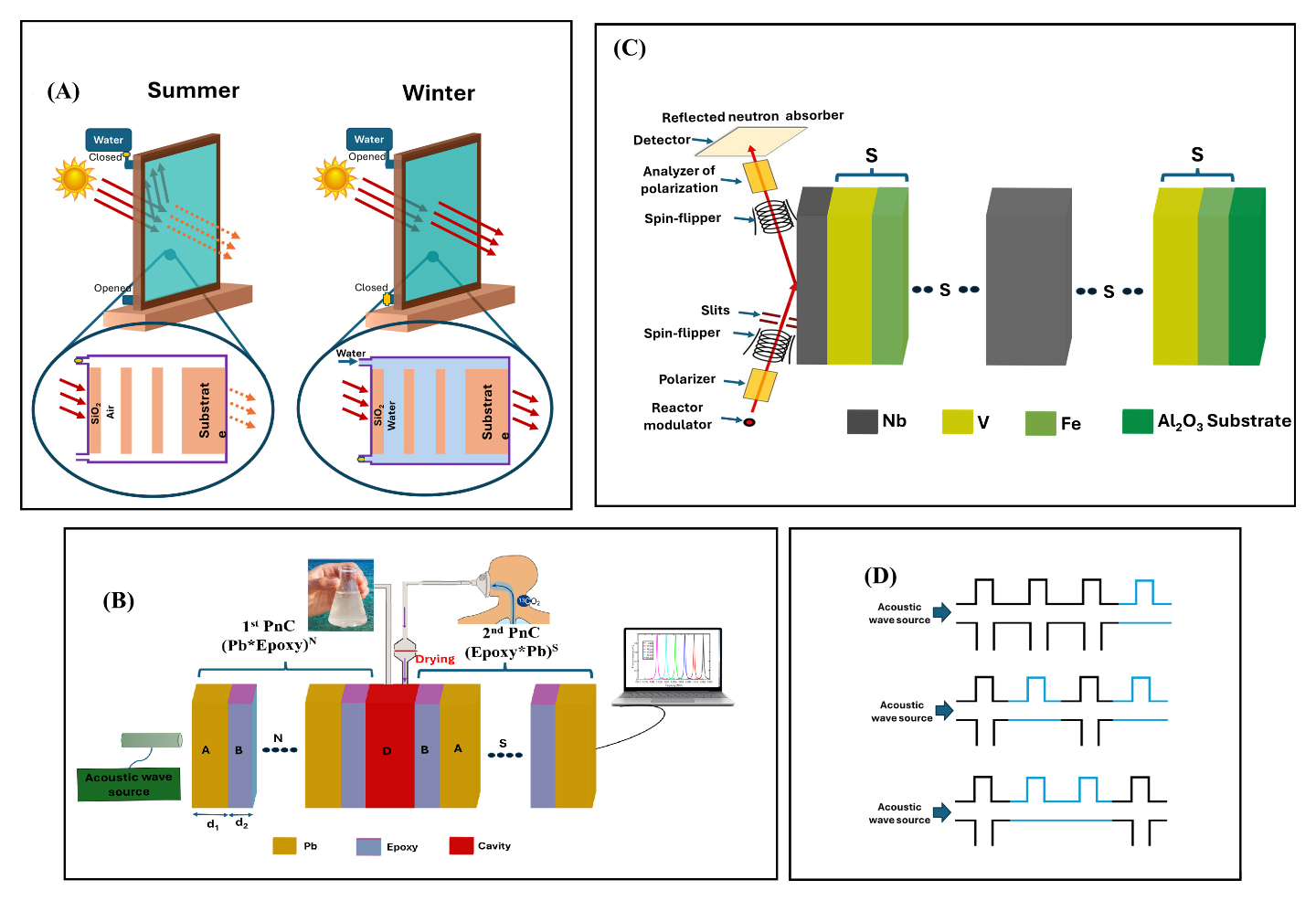
Led by the FLNP JINR specialist, scientists from research centres in Egypt, Saudi Arabia, and Morocco successfully applied models of multilayer thin-film structures to address challenges in several fields. Over the past four years, the researchers developed models for a “smart” window for energy saving in photonics (Sci. Rep. 12, 2022), a highly sensitive platform for biosensoring in phononics (Sci. Rep. 15, 2025), and an effective neutron spin filter (Plasmonics 20, 2025).
The new study, published in Scientific Reports, focuses on a more complex geometrical system: an acoustic waveguide with integrated lateral resonators. Rather than a simple periodic pattern, their arrangement follows the more complex aperiodic Thue-Morse sequence. Simulations showed that this structure allows for the creation of multiple, sharp, and tunable transmission peaks within the acoustic band gap. Further studies could pave the way for the development of high-precision acoustic filters capable of selectively transmitting several predefined frequencies simultaneously.
Although the research was conducted on acoustic systems, its findings are directly applicable to neutron physics. The formalism describing sound wave propagation in a waveguide with resonators is analogous to the equations for neutron transport in a channel with resonant absorbers.
“Our work shows that it is possible to describe and control wave processes in a wide variety of structured media within a single unified framework. This universality is important because it brings together approaches from photonics, phononics, and other wave systems, and can ultimately help in designing more efficient sensors and devices for practical applications,” Zaky Ibrahim commented on the research findings. “I would like to express my sincere gratitude to JINR, Beni‑Suef University, and the Academy of Scientific Research and Technology, Egypt, for their continuous support”.
Thus, the scientists’ work establishes a conceptual framework for the development of innovative neutron optical devices. In the future, this model could be used to create neutron guides that ensure unprecedented precision in spectral or spatial selection. Such technologies could significantly enhance the capabilities of experimental facilities at pulsed neutron sources, including the IBR-2 Reactor at FLNP at JINR.
Illustration of different wave-control structures studied: (A) a multilayer smart optical window, (B) a multilayer phononic crystal biosensor, (C) a multilayer neutron spin-filter, and (D) a waveguide with integrated lateral resonators in a Thue-Morse sequences