A new study published in the Journal of Manufacturing and Materials Processing investigates a novel Al-7.9Gd-0.6Zr-0.2Cr-0.2Ti alloy that shows promise as a thermal neutron absorption material. Following homogenization at 615 °C, the alloy develops a unique core-shell structure, with an Al21GdCrTi core surrounded by an Al3(Gd,Zr) shell alongside coherent L1₂ nanoprecipitates of 20-25 nm in size dispersed in the matrix. Due to the presence of gadolinium (neutron capture cross-section of 48,800 barns), a 1-mm-thick layer of the alloy reduces the intensity of neutrons scattered from pure aluminum by a factor of 17-36 (measured using the SKAT instrument at the IBR-2 reactor), depending on the neutron wavelength. Mechanical tests show that cold rolling provides a yield strength of 175 MPa and an elongation of 11.9%, while hot-cold rolling results in 164 MPa and 13.5%, respectively. The ultimate tensile strength in both cases is approximately 203 MPa. Texture analysis revealed grain reorientation after rolling: the (111) pole density maximum shifts from the center to 30° from the normal direction. The alloy combines high neutron shielding efficiency with good castability and workability.
(a) Microstructure after solution treatment at 615 ◦C for 1 h and quenching of the Al−Gd−Zr−Cr−Ti alloy at low and high magnification (SEM), and (b) EDX spectra from the Al solid solution of the Al−Gd−Zr−Cr−Ti. 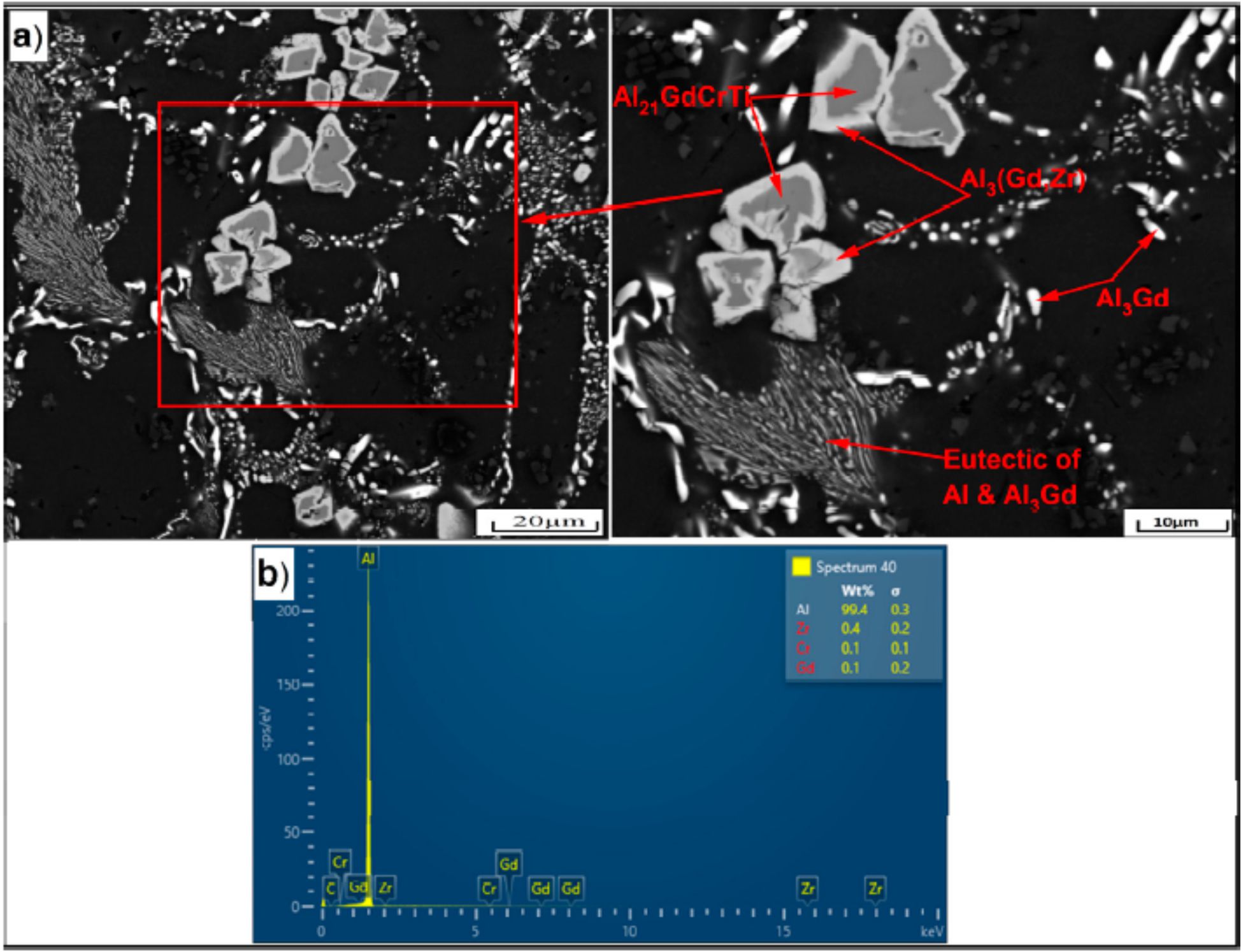
Source: S. M. Amer, A. El-Khouly, D. Nikolayev, T. A. Lychagina, Amr. B. ElDeeb, L. E. Gorlov, O. A. Yakovtseva, R. Yu. Barkov, M. V. Glavatskikh, A. V. Pozdniakov. Influence of Zr Addition on the Phase Composition, Mechanical Properties, Deformation Behavior and Crystallographic Texture of the Al−Gd−Cr−Ti Alloy for Thermal Neutron Absorption. J. Manuf. Mater. Process. 2026, 10(6), 186. https://doi.org/10.3390/jmmp10060186. License: CC BY 4.0.
The article was carried out jointly with NUST MISIS and S. M. Amer.